
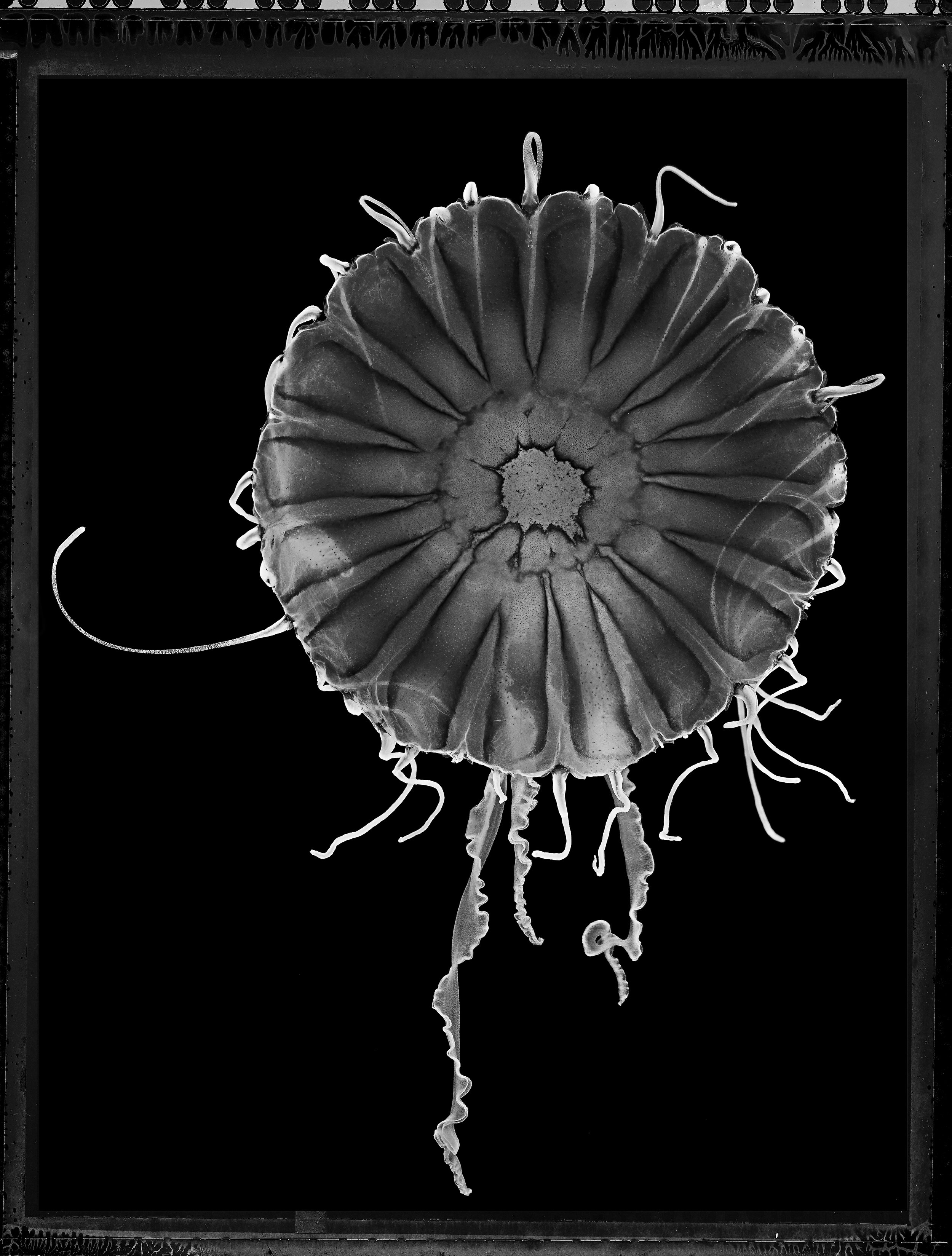
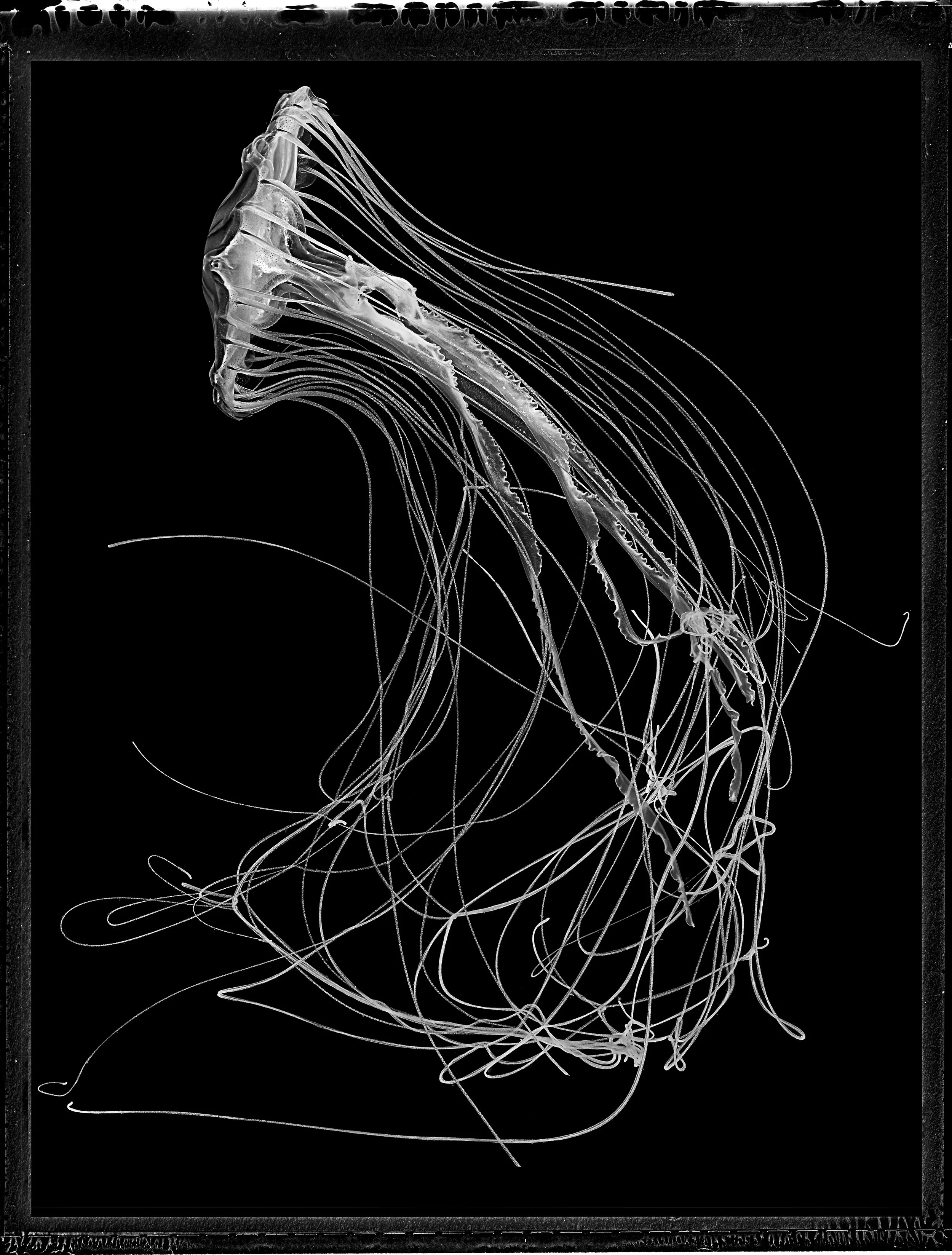
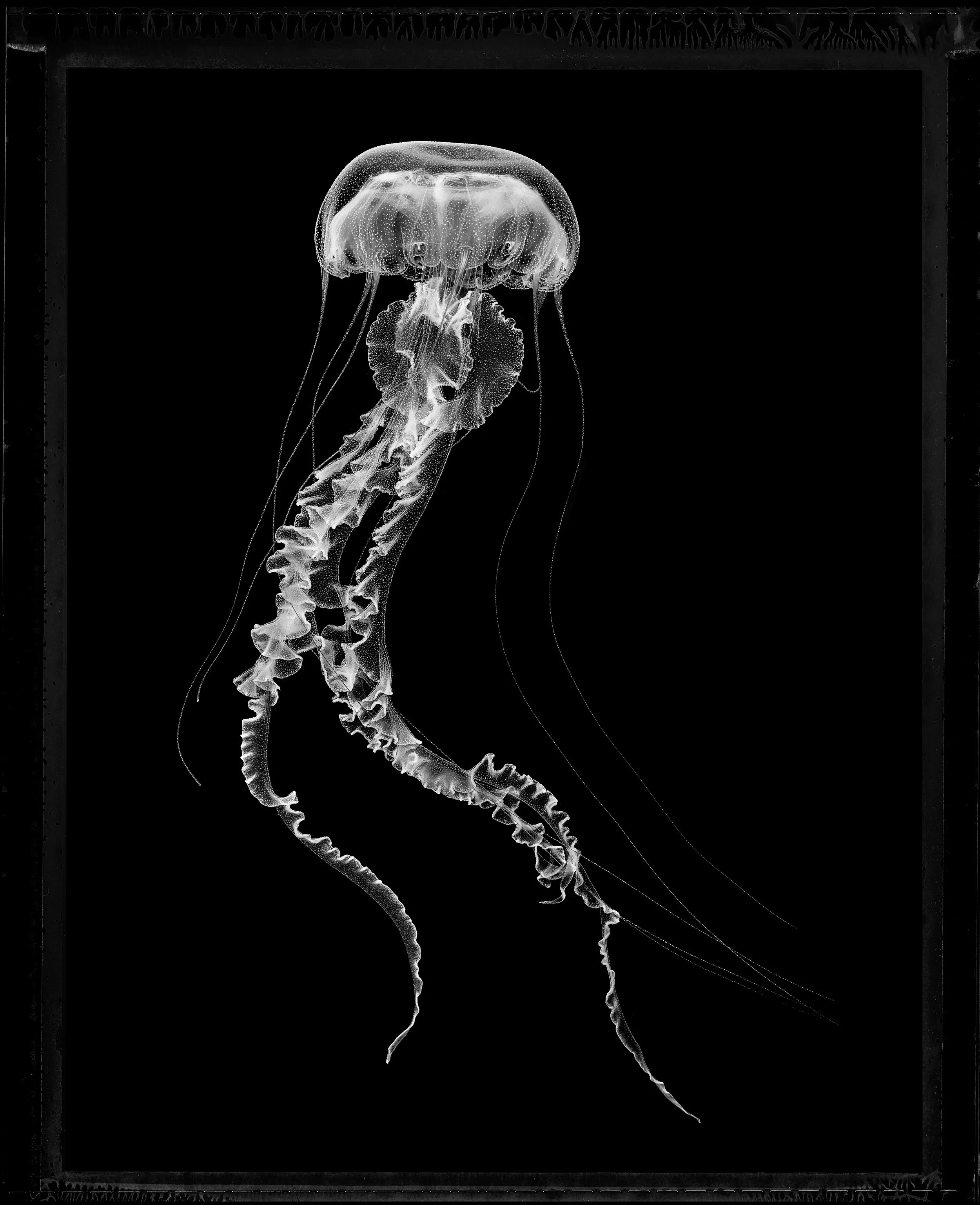
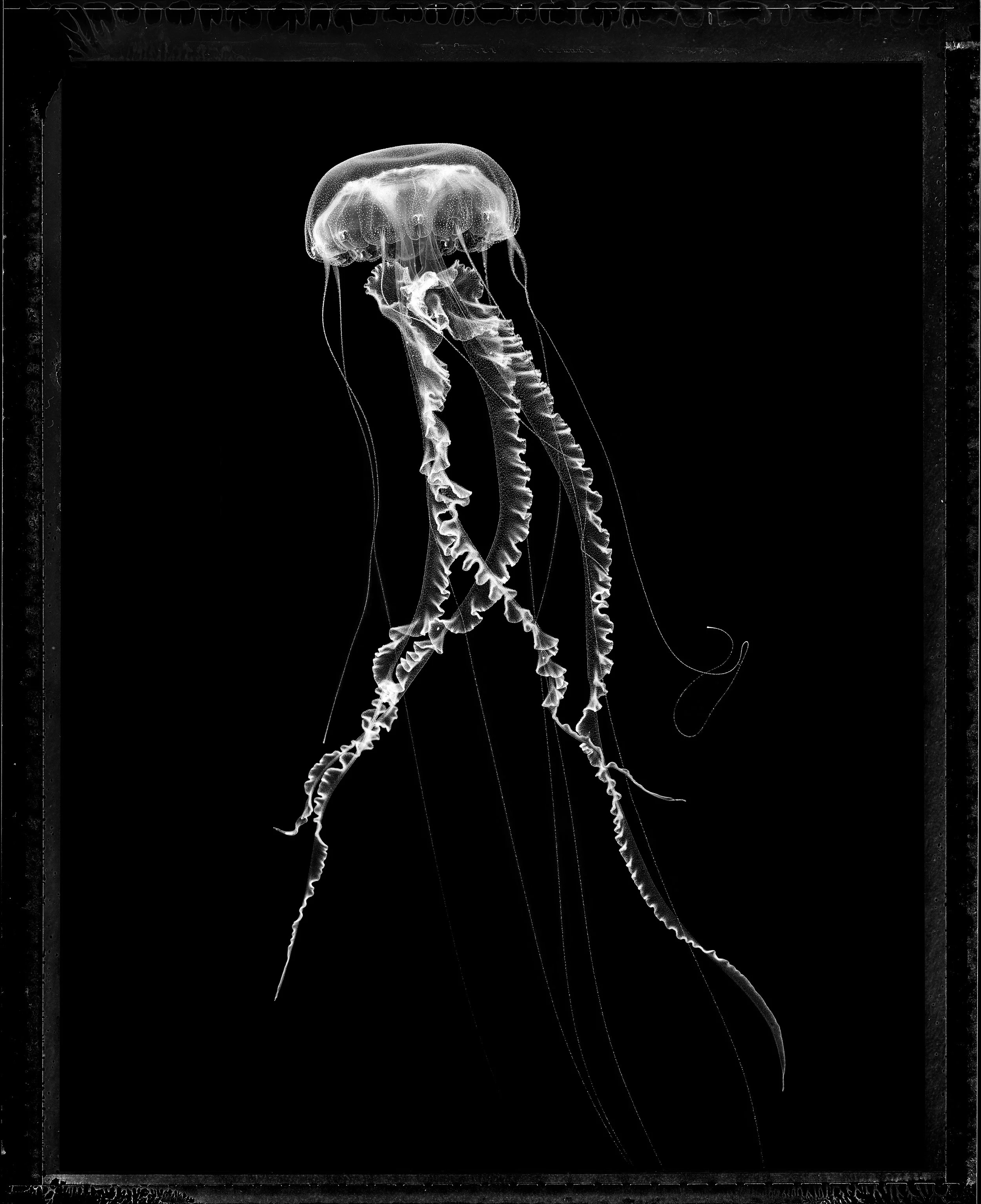
Of aliens, Mermaids and Medusas, Platinum Prints
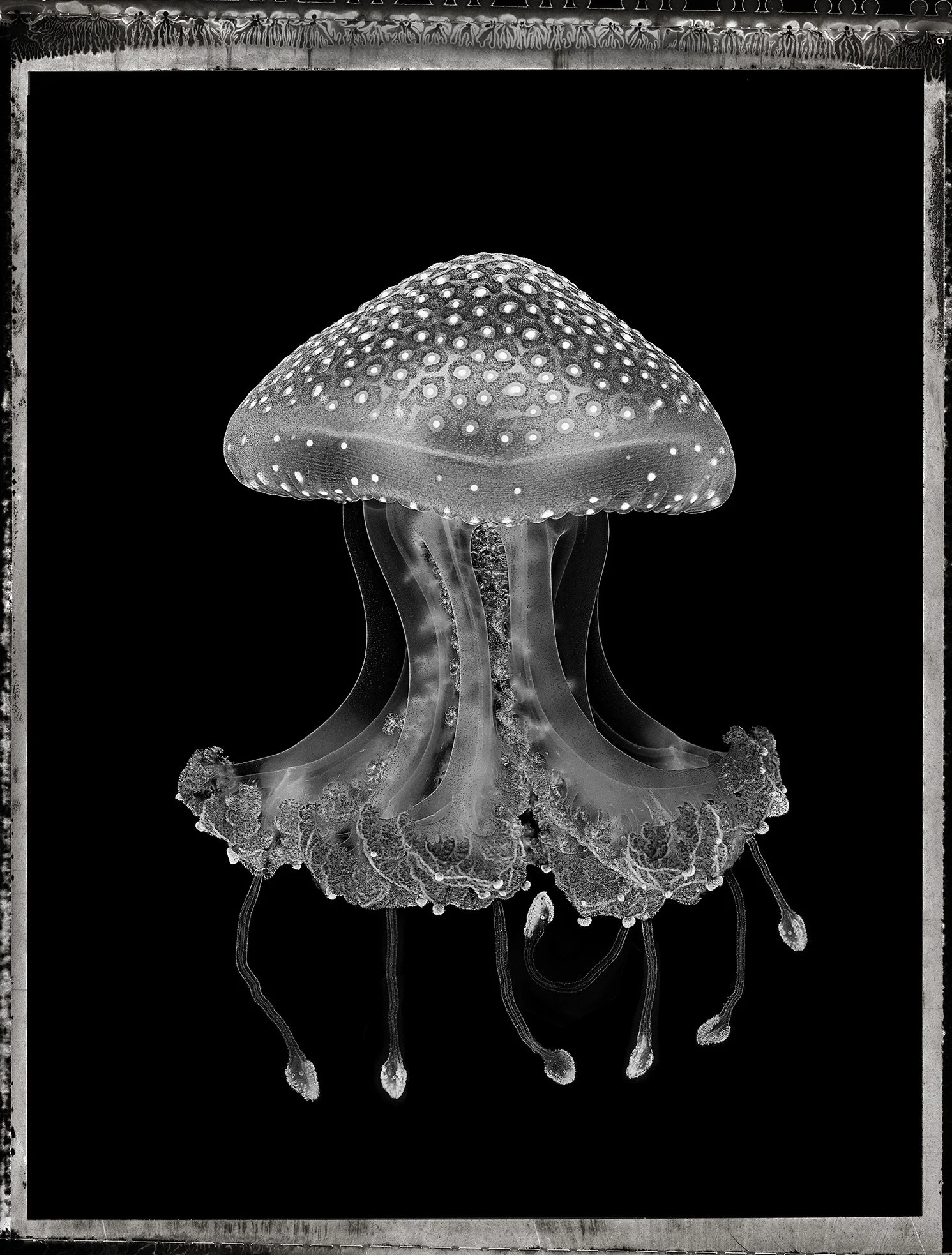
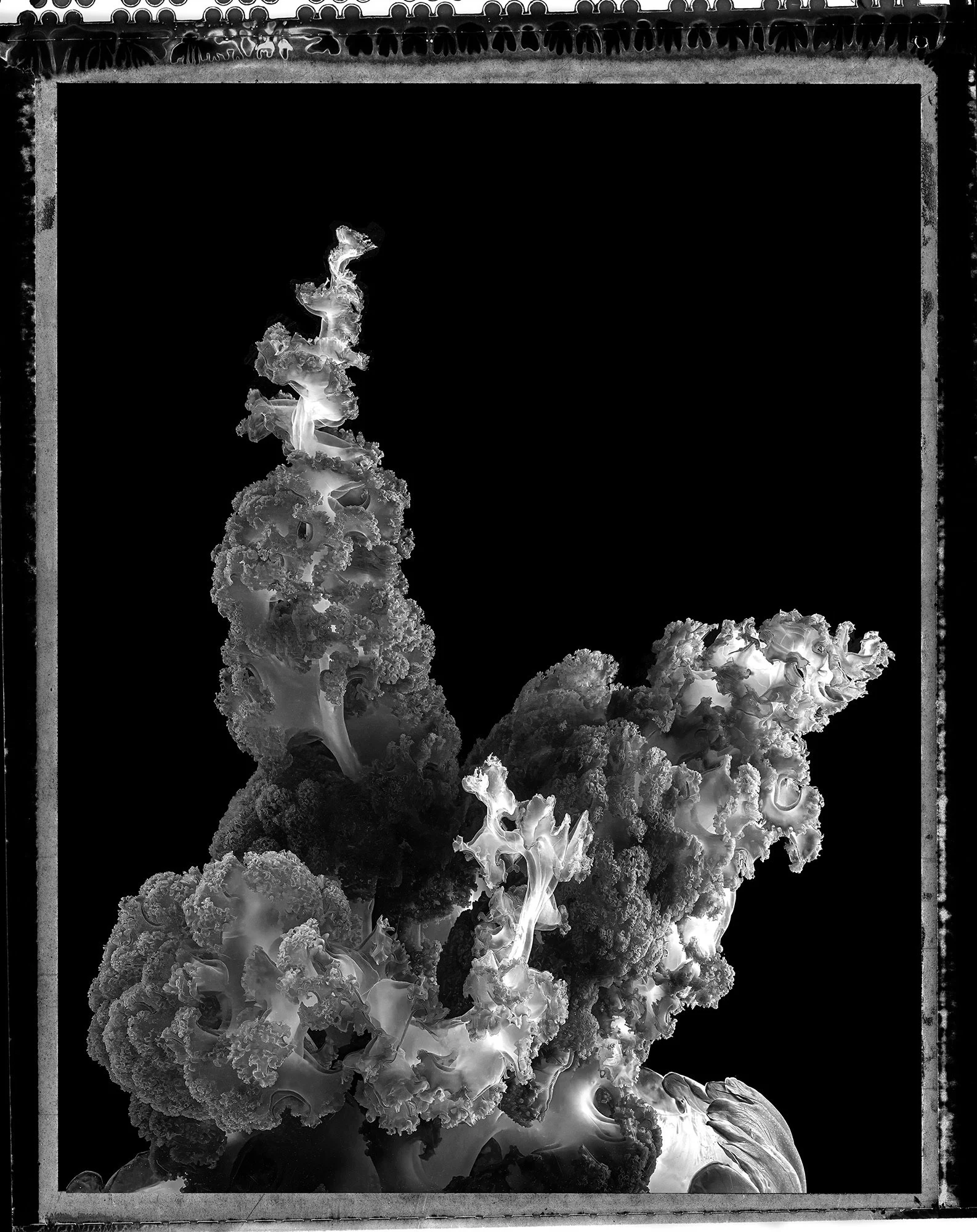
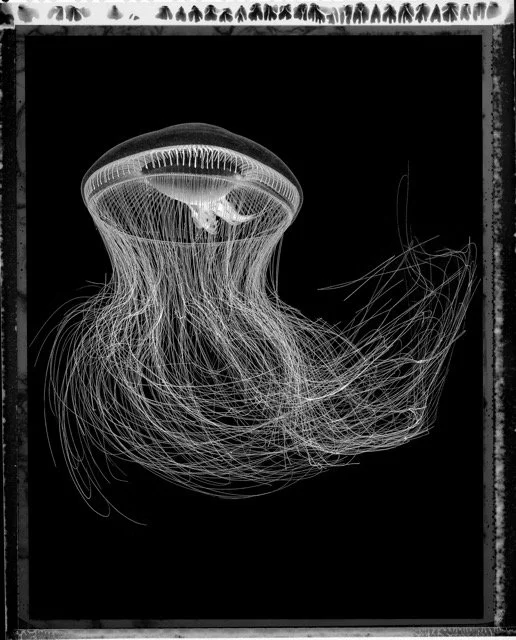
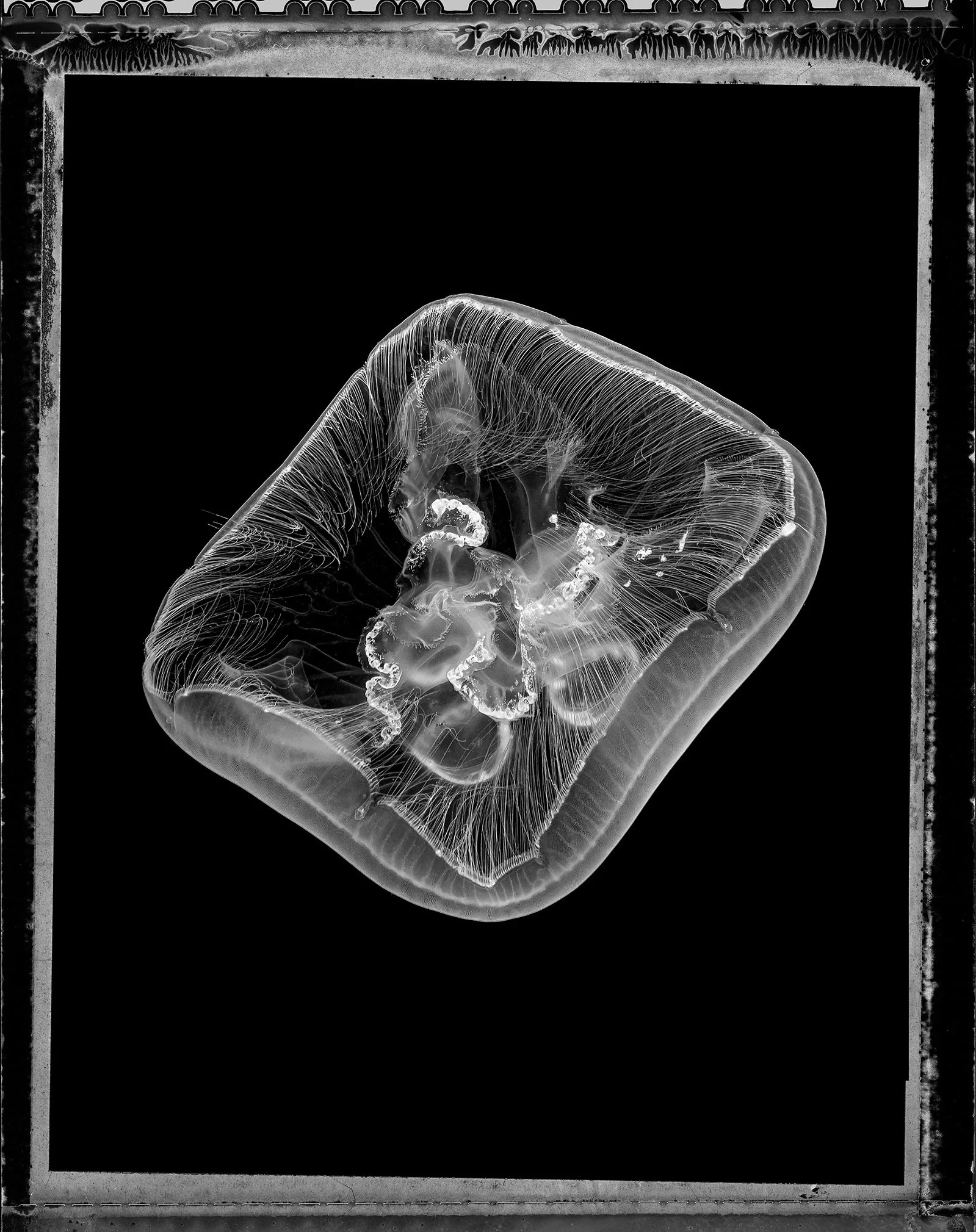
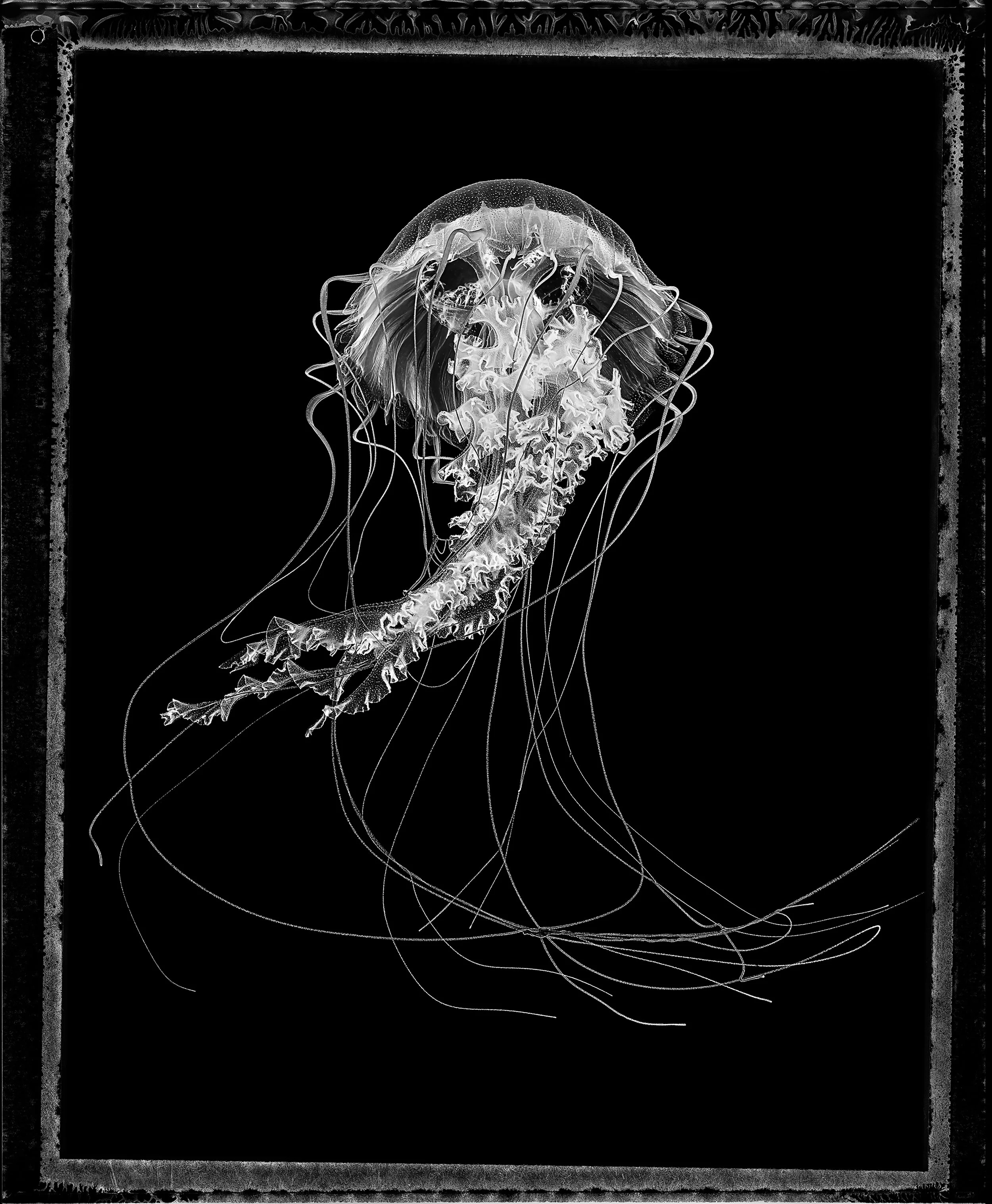
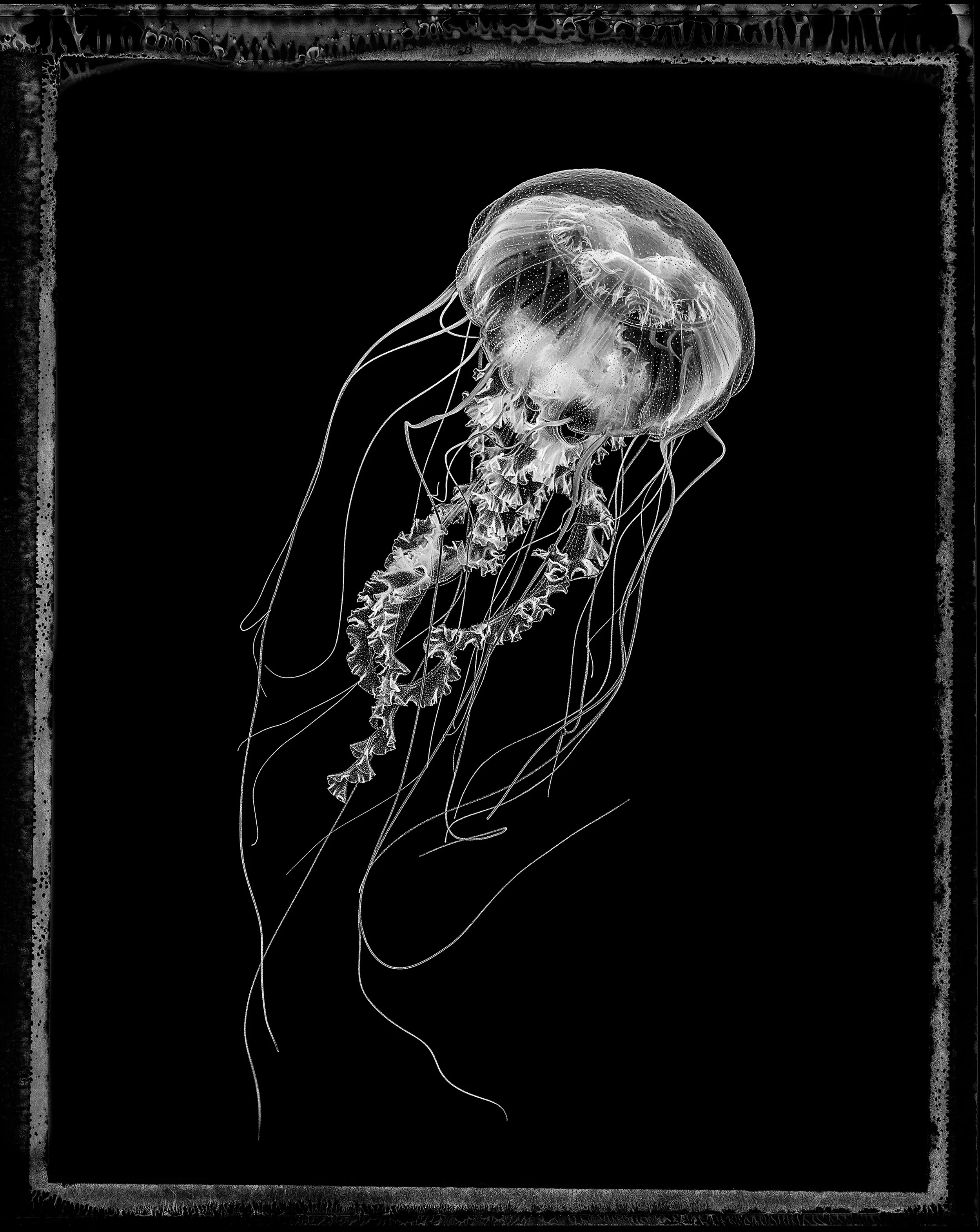
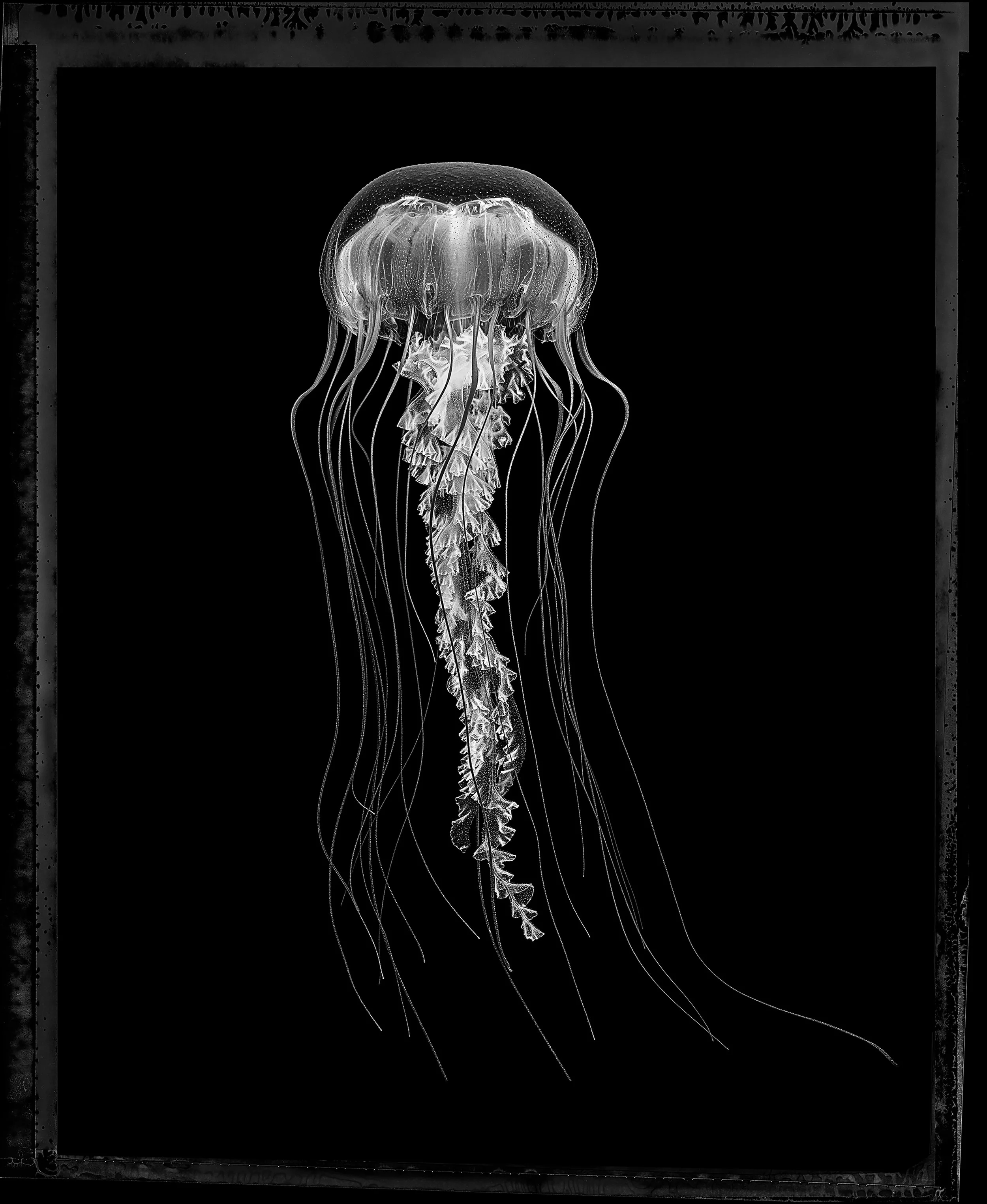
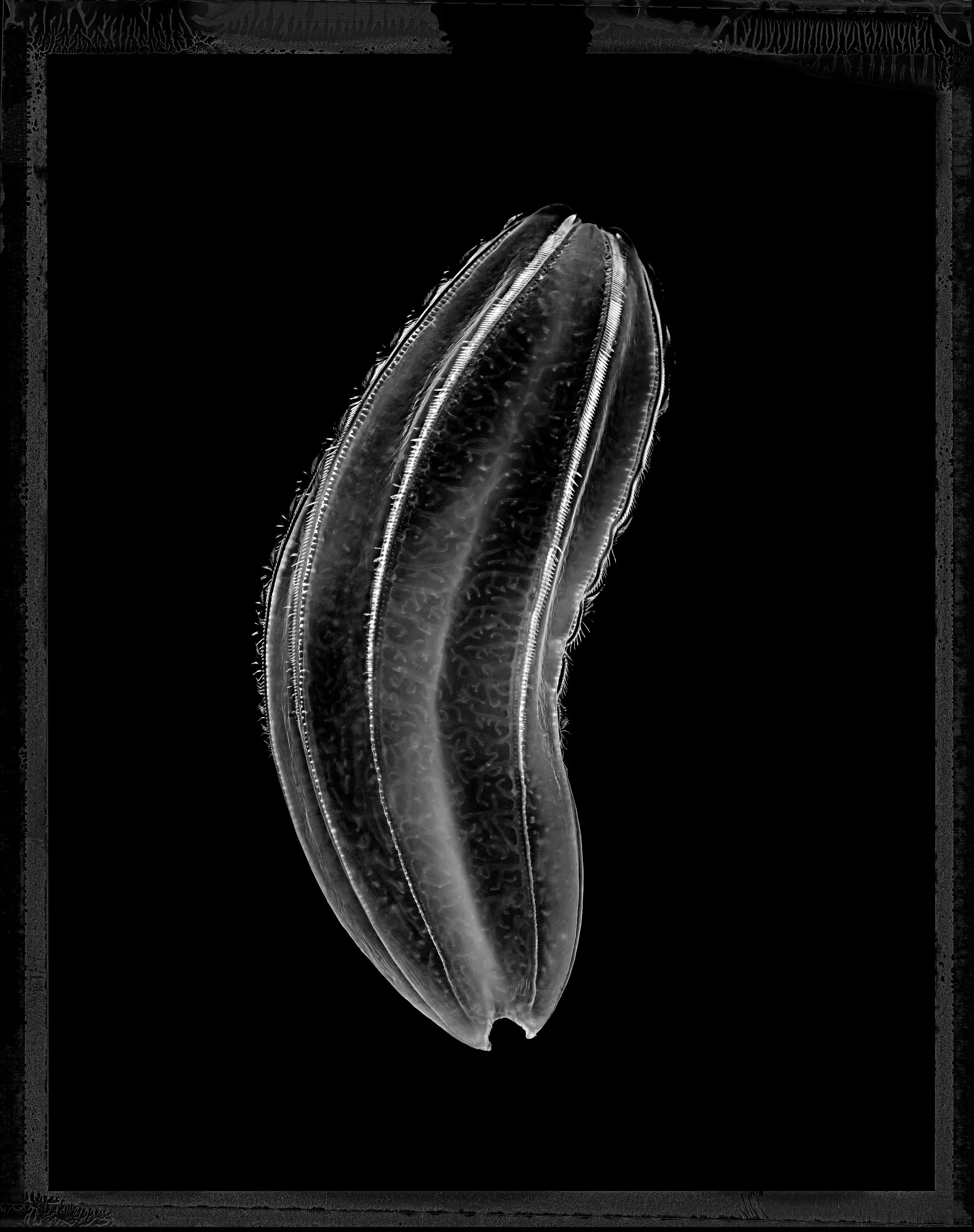
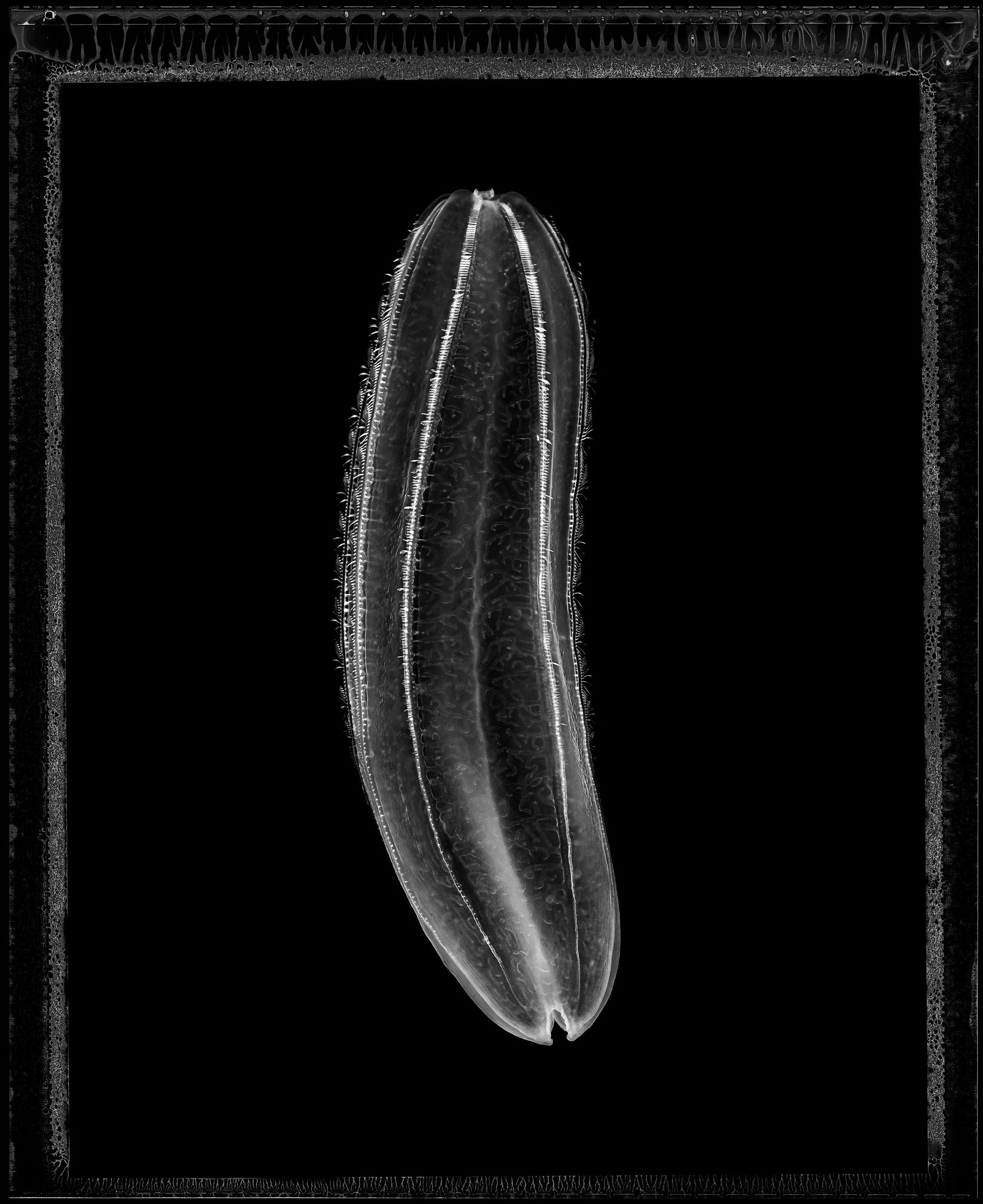
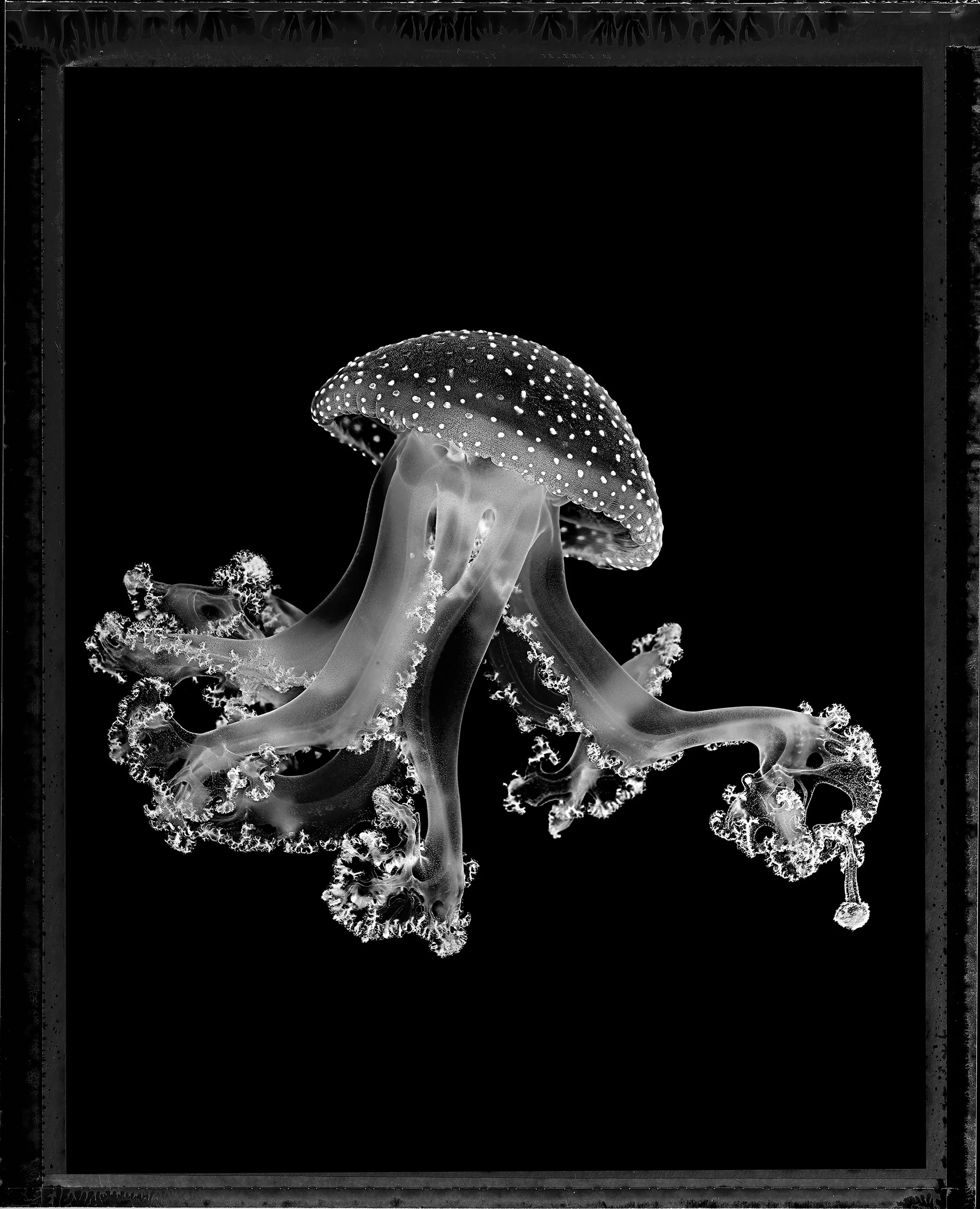
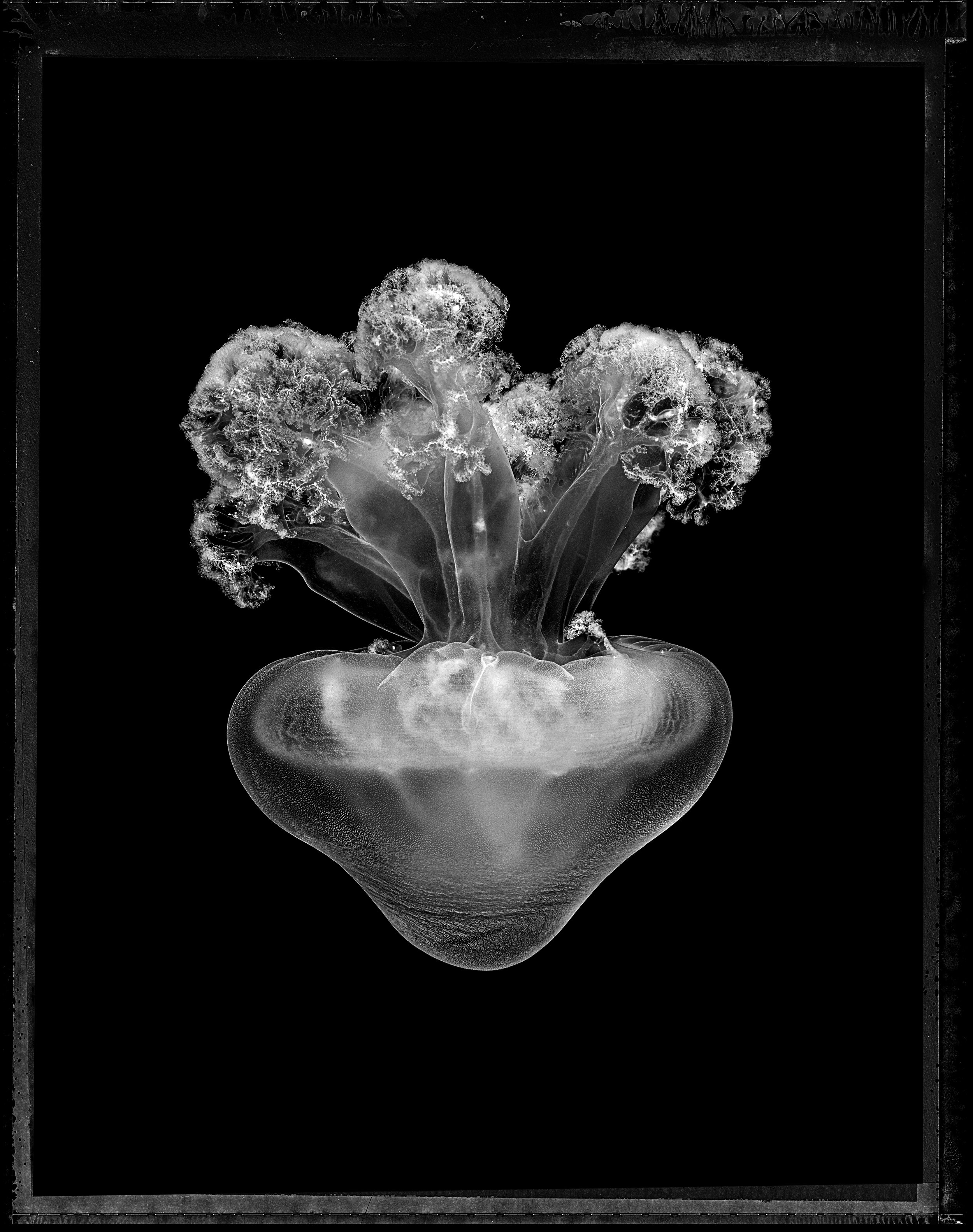
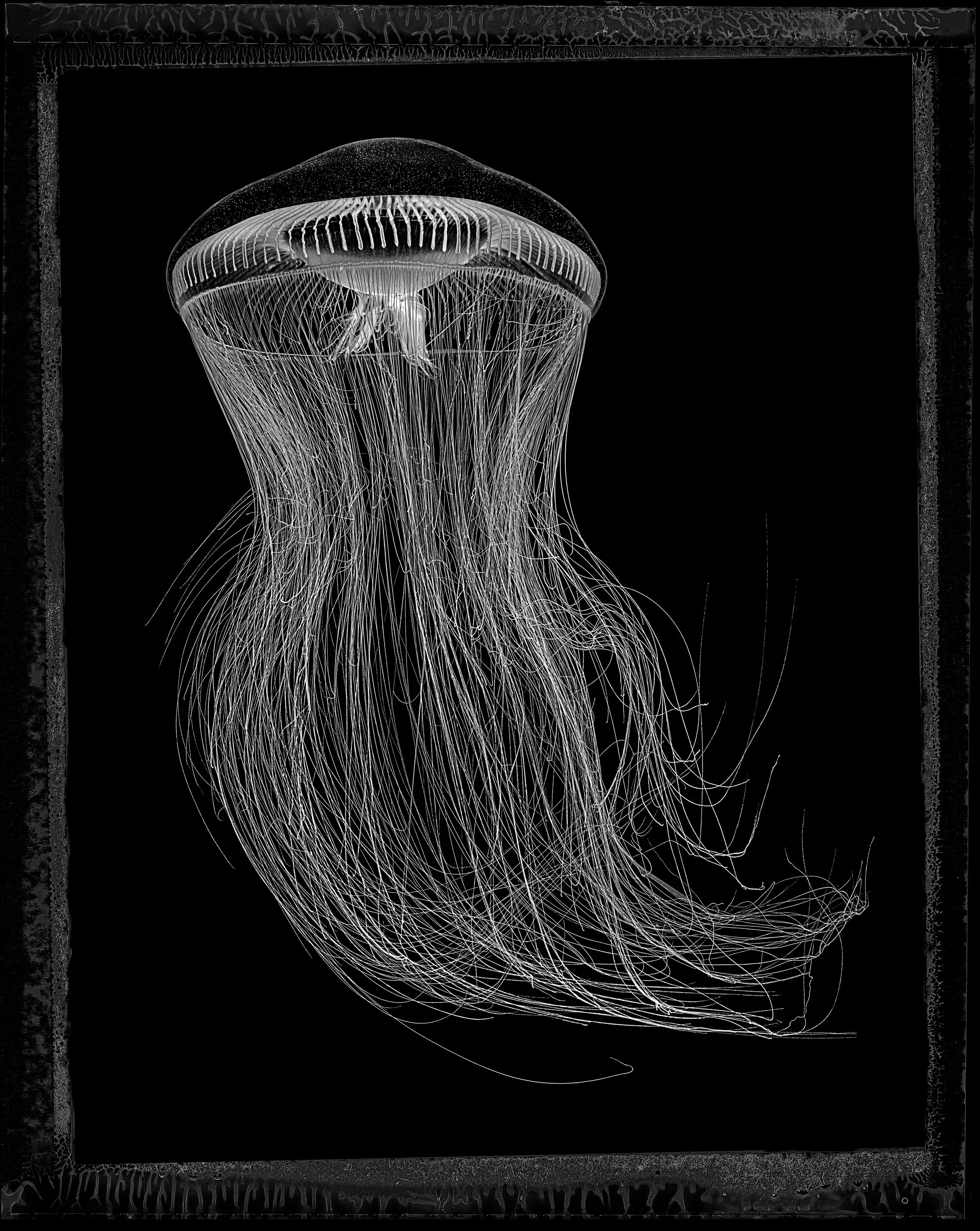
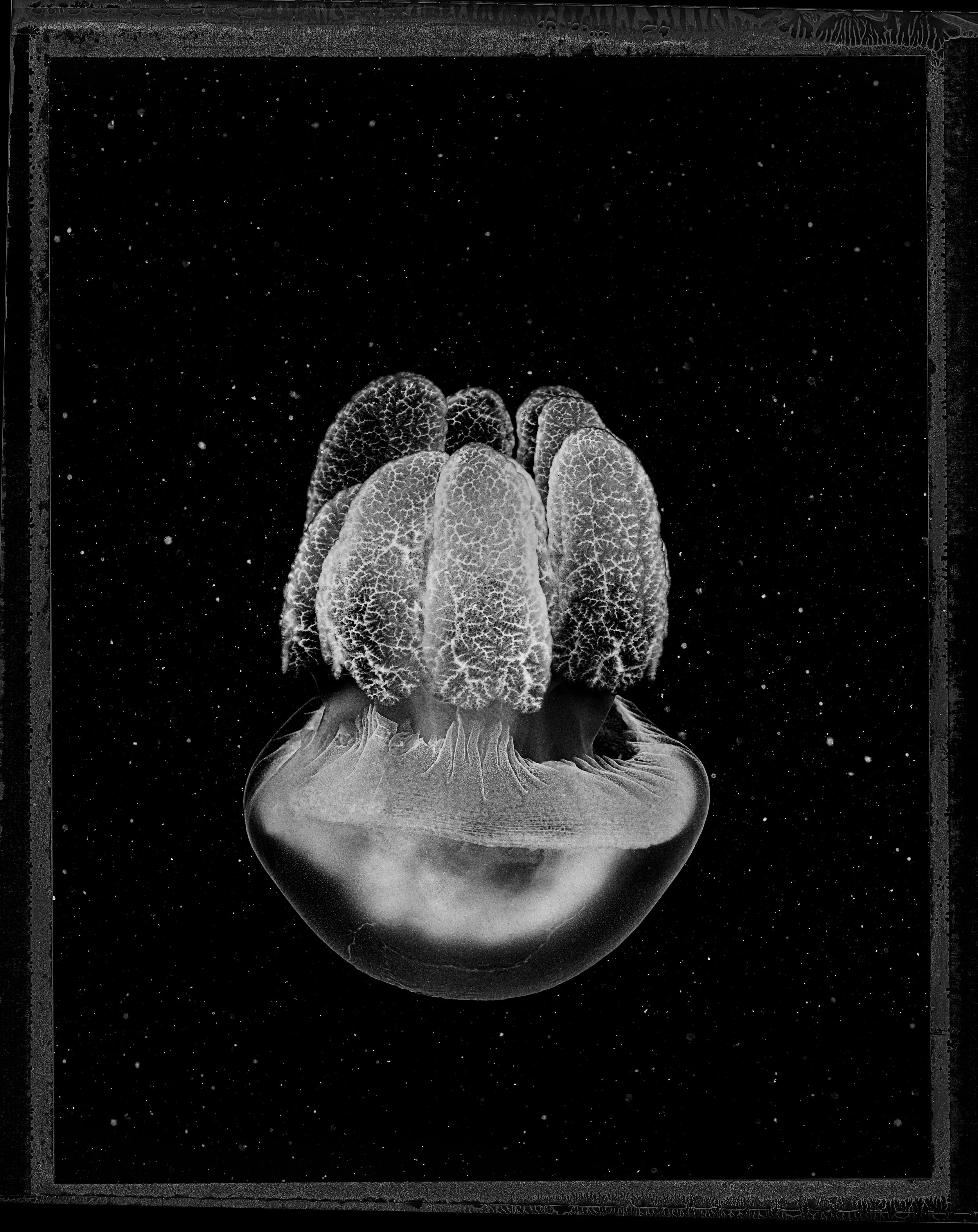
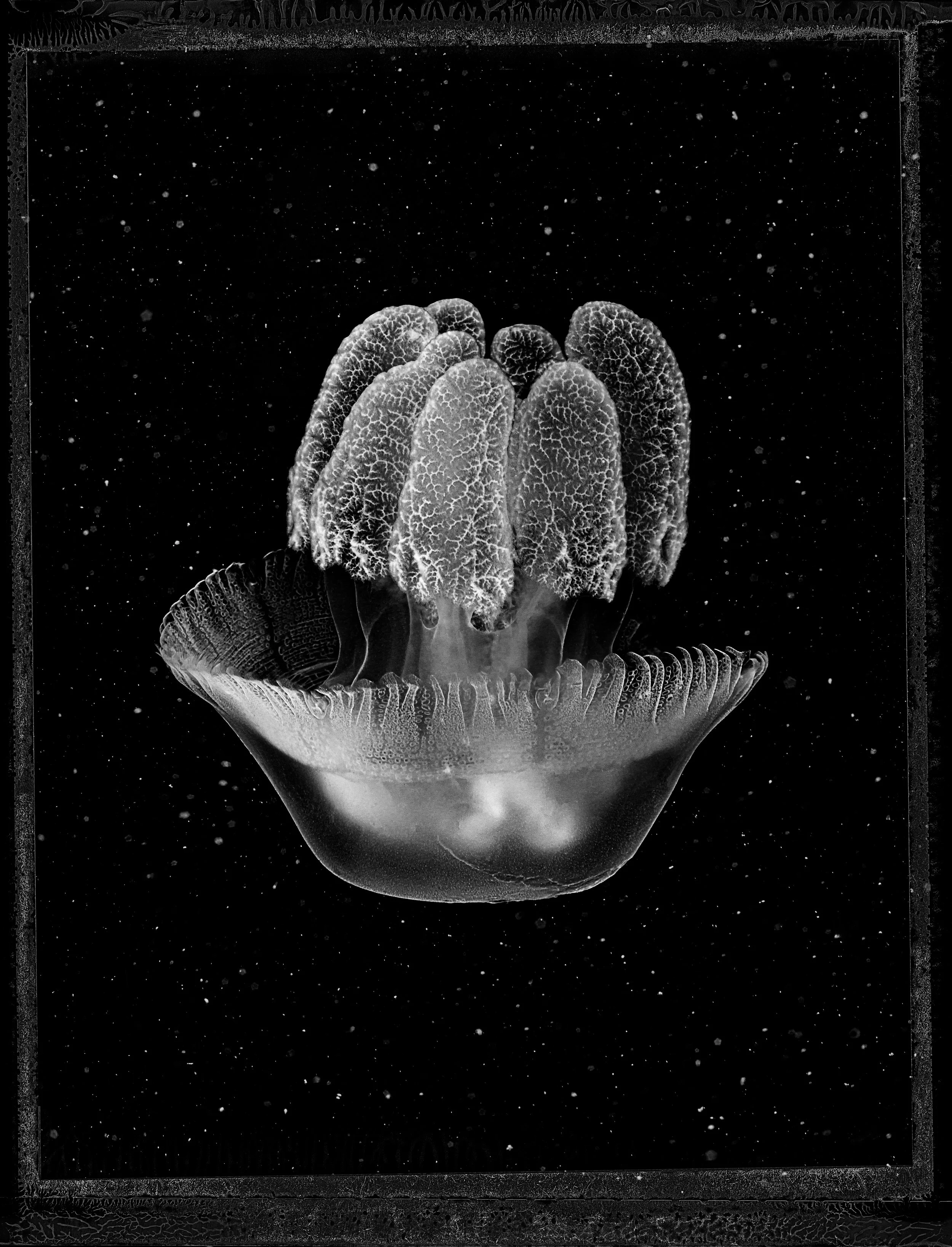
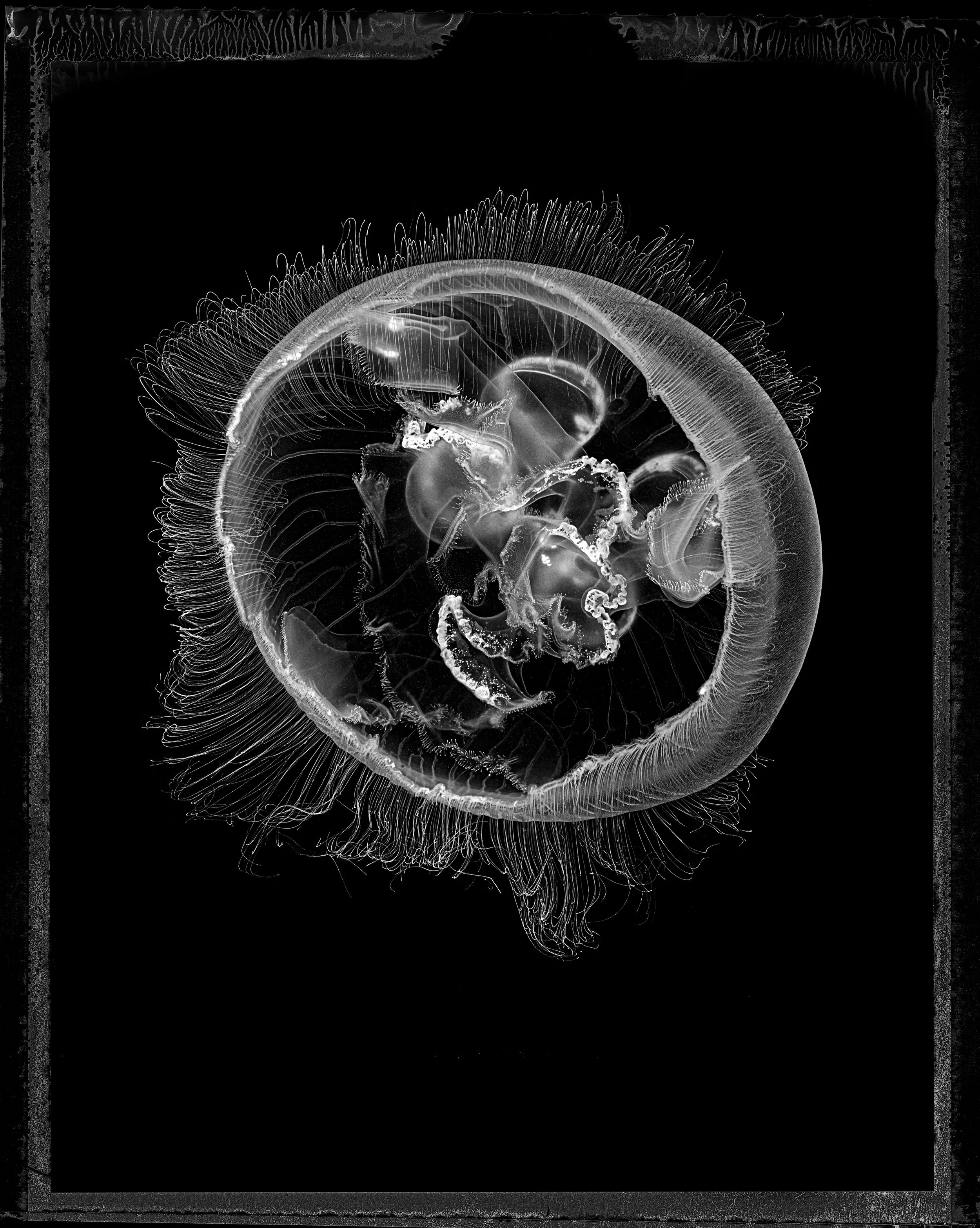
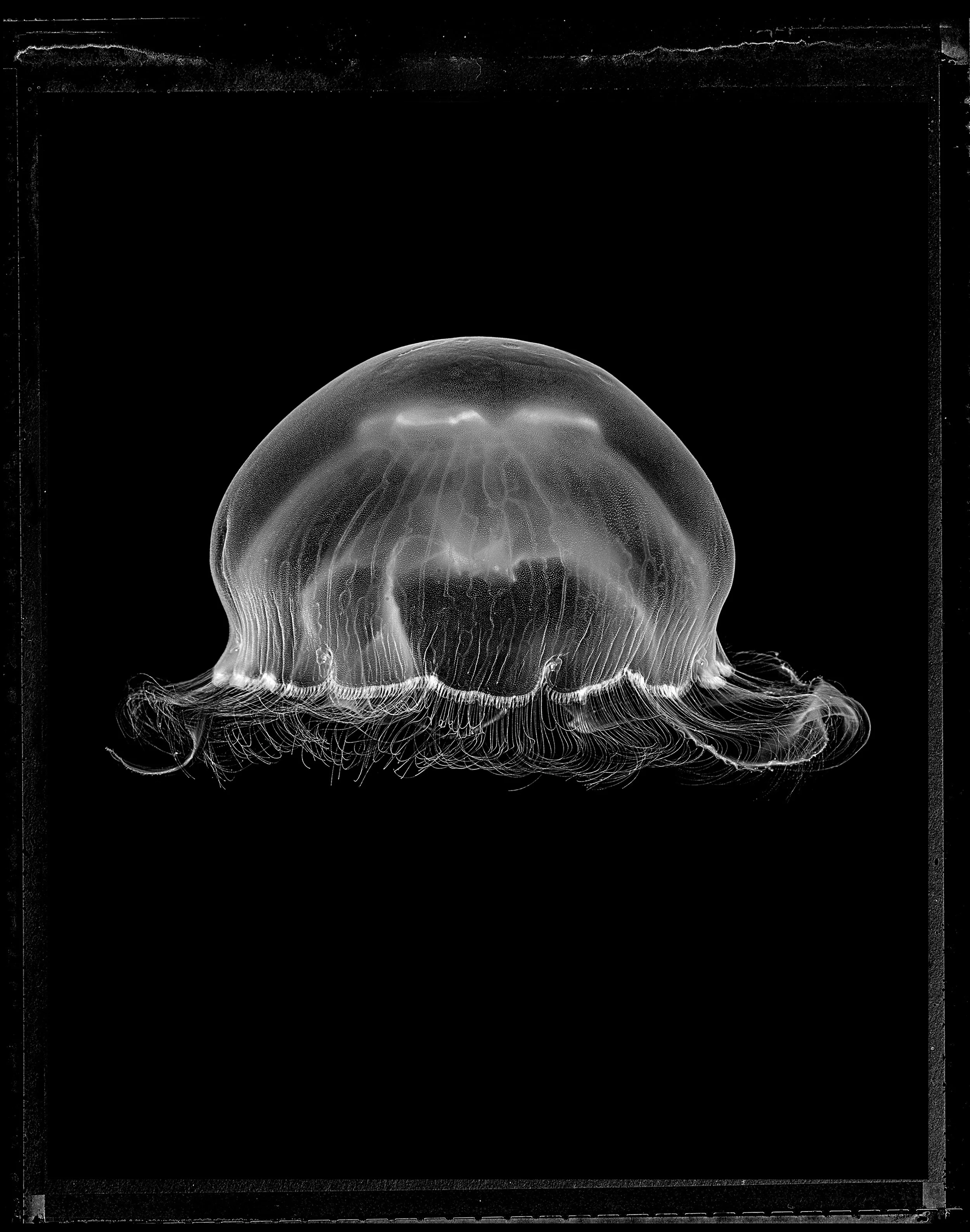
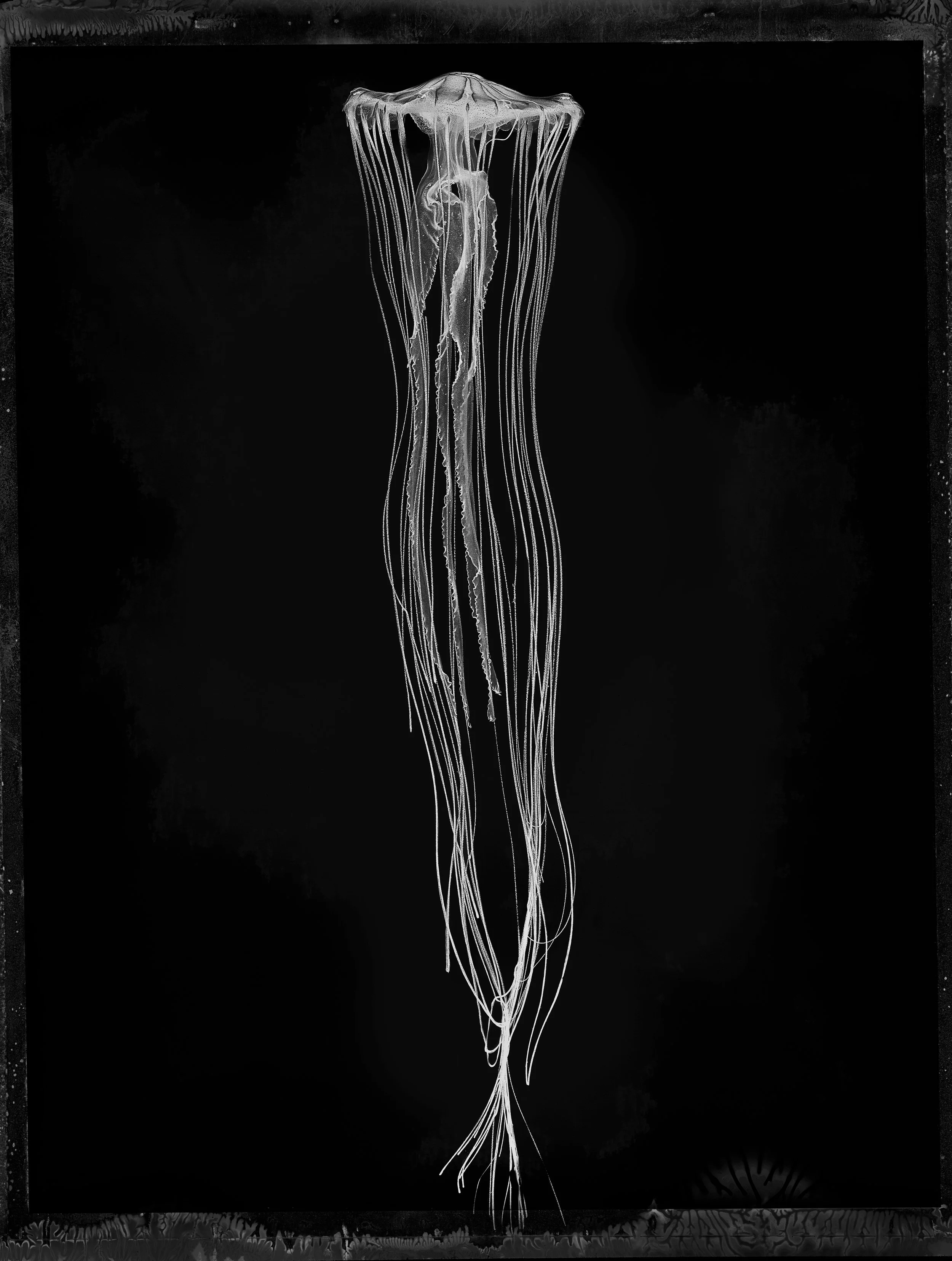
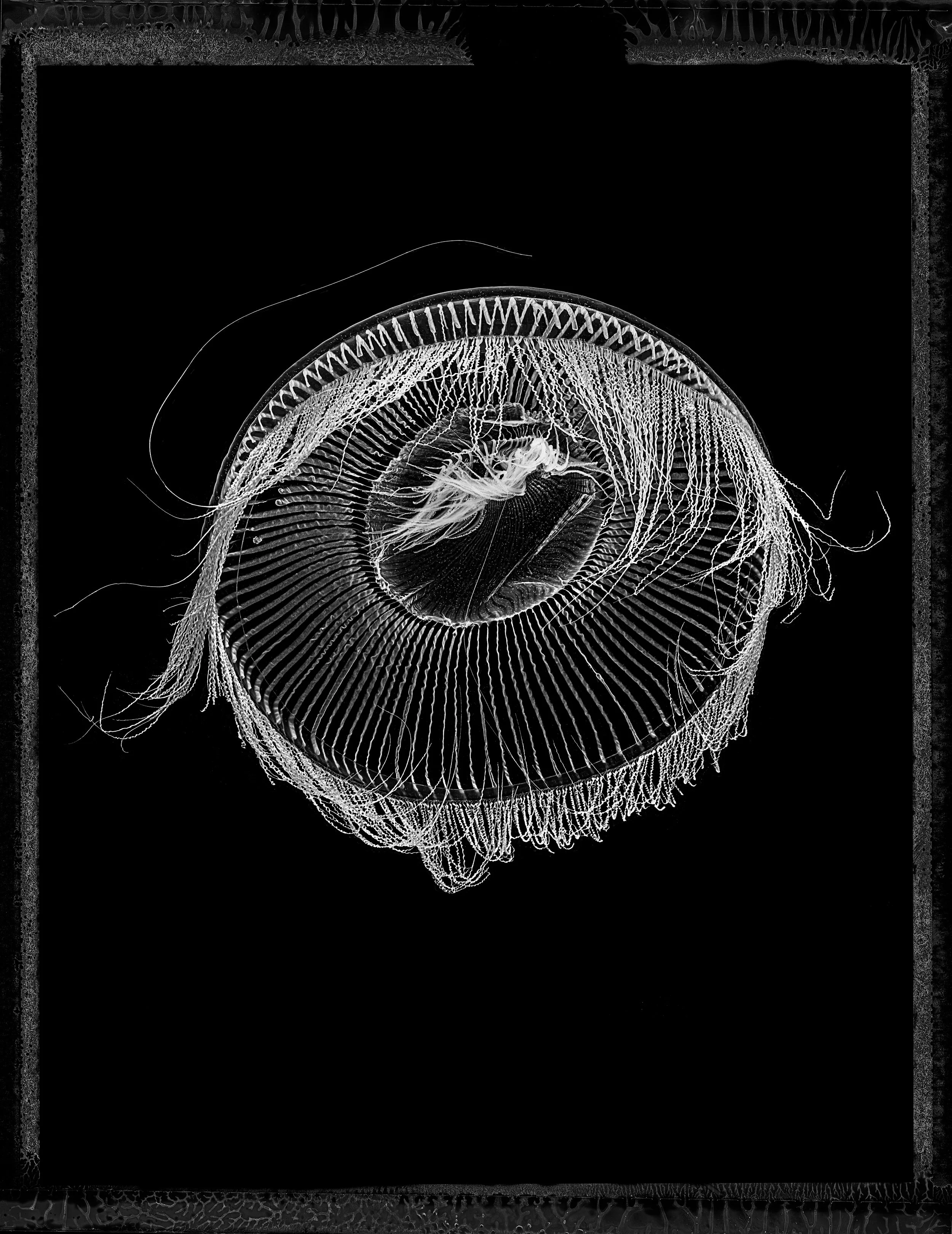
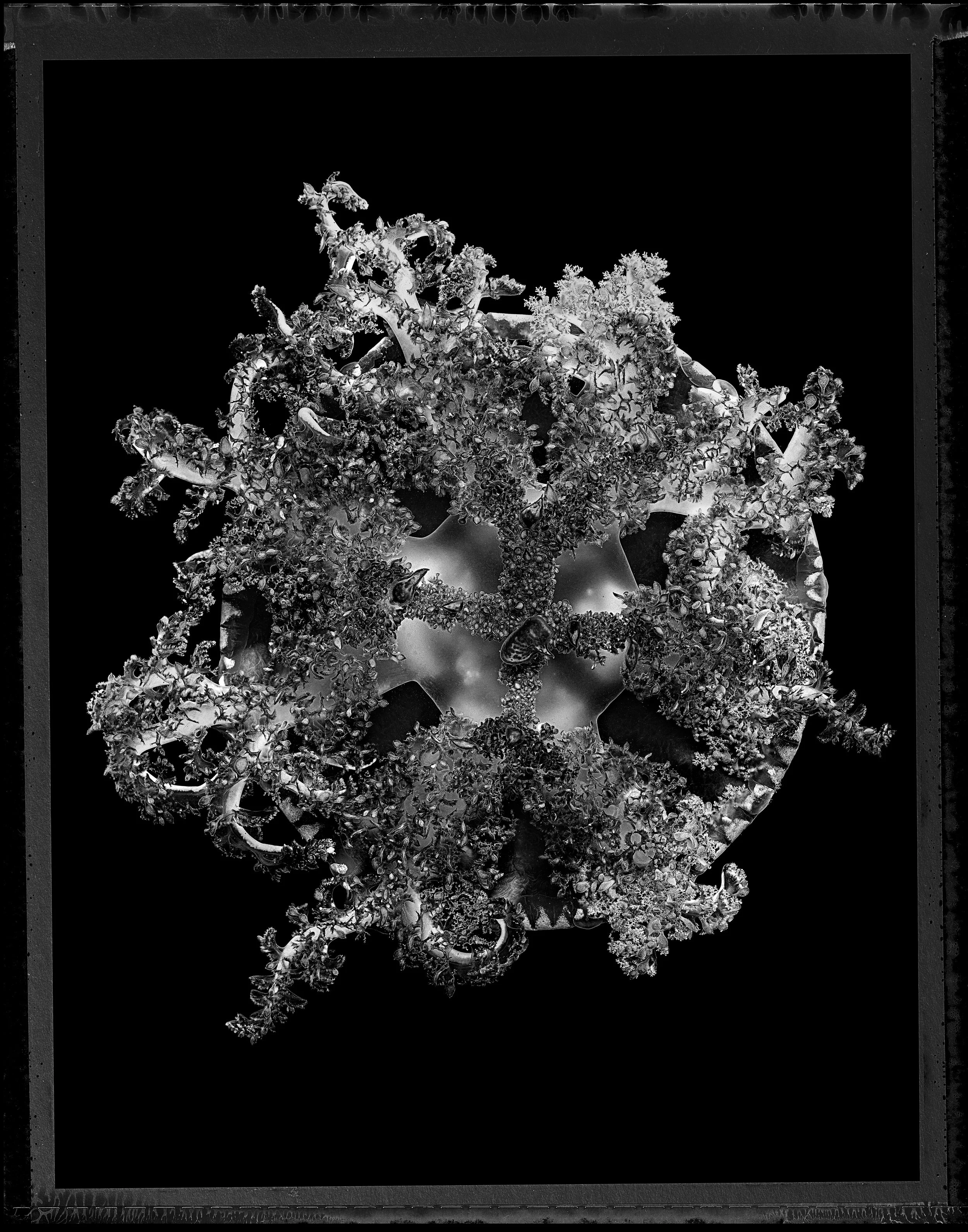
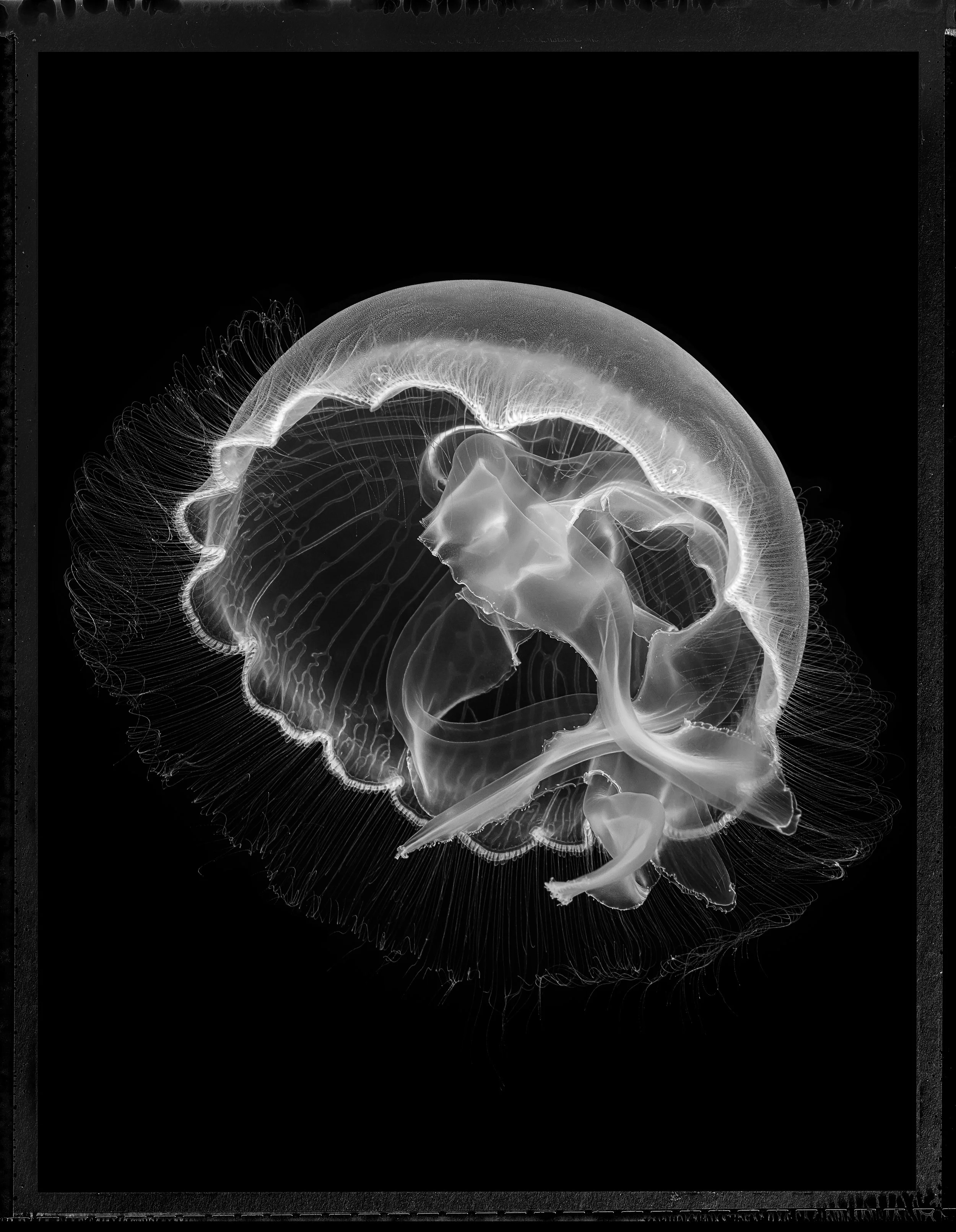
Of Aliens, Mermaids and Medusas is a series of handmade platinum print photographs by German fine art photographer Jan Schlegel, dedicated to the quiet and otherworldly presence of jellyfish. Suspended in darkness, these forms appear almost weightless—at once fragile and timeless, drifting between abstraction and biological reality.
Each work is created as a handmade platinum print in strictly limited editions from large format film, a process known for its exceptional tonal depth and permanence. The images are produced in carefully limited editions and are held in private collections, galleries, and institutions.
Rather than documenting marine life, the series invites a contemplative encounter. The jellyfish becomes a presence—ambiguous, meditative, and elusive—evoking associations that move between the natural world and the imagination.
Available as limited edition single prints in sizes of 56 × 76 cm and 40 × 50 cm, as well as a complete set of 27 works presented in a handmade portfolio.
Presented at leading international art fairs, including Paris Photo, AIPAD New York, and Photo London.
The series „of Aliens, Mermaids and Medusas" was inspired by imagination itself.
Today it seems as if its influence on people is losing its power because we begin to forget or stop noticing how imagination can change our lives. It is the way people approach all kinds of problems with creativity.
We live in a time of crisis when everything in the world has been turned upside down by global warming, ocean pollution, the coronavirus pandemic, and wars (just to mention a few). We have to deal with everyday problems, and this is quite difficult in a state of anxiety. In addition, we are attacked by negative news, and in this information noise, the voice of our imagination that helps us to cope mentally is drowned out.
We do not mean an escape from reality to completely lose touch with it, but a deeper dive into your inner world, where the answers to all questions lie. The ability to imagine, to think outside the box, encourages us to change for the better.
How long ago have you been peering into quirky, chaotic at first glance patterns to discern unusual images in them? How long ago have you laid with a friend on the grass, looking up at the sky and saying, "That cloud looks like a jumping tiger!"? Jan C Schlegel's series of photographs will help you revive your imagination. Just take a closer look at the most primitive, yet incredibly complex creatures: jellyfish.
Jellyfish appeared long before the dinosaurs. They inhabited the ocean 500-700 million years ago, at the dawn of life on Earth. They have no blood, bones or brain, but thanks to evolution, these organisms have developed very cunning methods of adaptation, some secrets of which scientists have not yet managed to unravel. Bizarre camouflage is the most understandable means of adaptation. But there are many unsolved mysteries. Why would a sea creature without a brain need eyes? How can some individuals transform from adult jellyfish to polyps without any limitations, thereby repeating the life cycle and providing themselves with actual immortality?
To date, scientists have described nearly 3,200 species of jellyfish, and the number is only growing every year. The in-depth study of jellyfish has made it possible to advance in solving the ecological problem of plastic emissions into the ocean. Geneticists are grappling with the question of immortality and suggest that the very same immortal jellyfish will help them get a little closer to answering this important question.
It was these amazing, little-studied creatures that attracted the attention of Jan C Schlegel, and he has attempted to show them from a different perspective. The project was photographed in Germany, at the artist’s house, and the Two Oceans Aquarium in Cape Town, South Africa.
The jellyfish placed in large aquariums moved chaotically, and their movements were meditative and calming. These are the moments when the magic of the imagination happens. The relaxed mind is attuned to observation. The smooth movements of the jellyfish seemed to show some pictures, and Jan only had to follow them and catch the moment.
Each person has their own unique experience, so we guess you'll see something of your own. You can look at the jellyfish silhouette as a whole or you can gaze at a particular element. You can focus on the pattern of the tentacles or the unusual fibers that make up the jellyfish's pileus. All of Jan's photos are chosen so that with a little effort you can see something really unexpected. Just take a closer look.
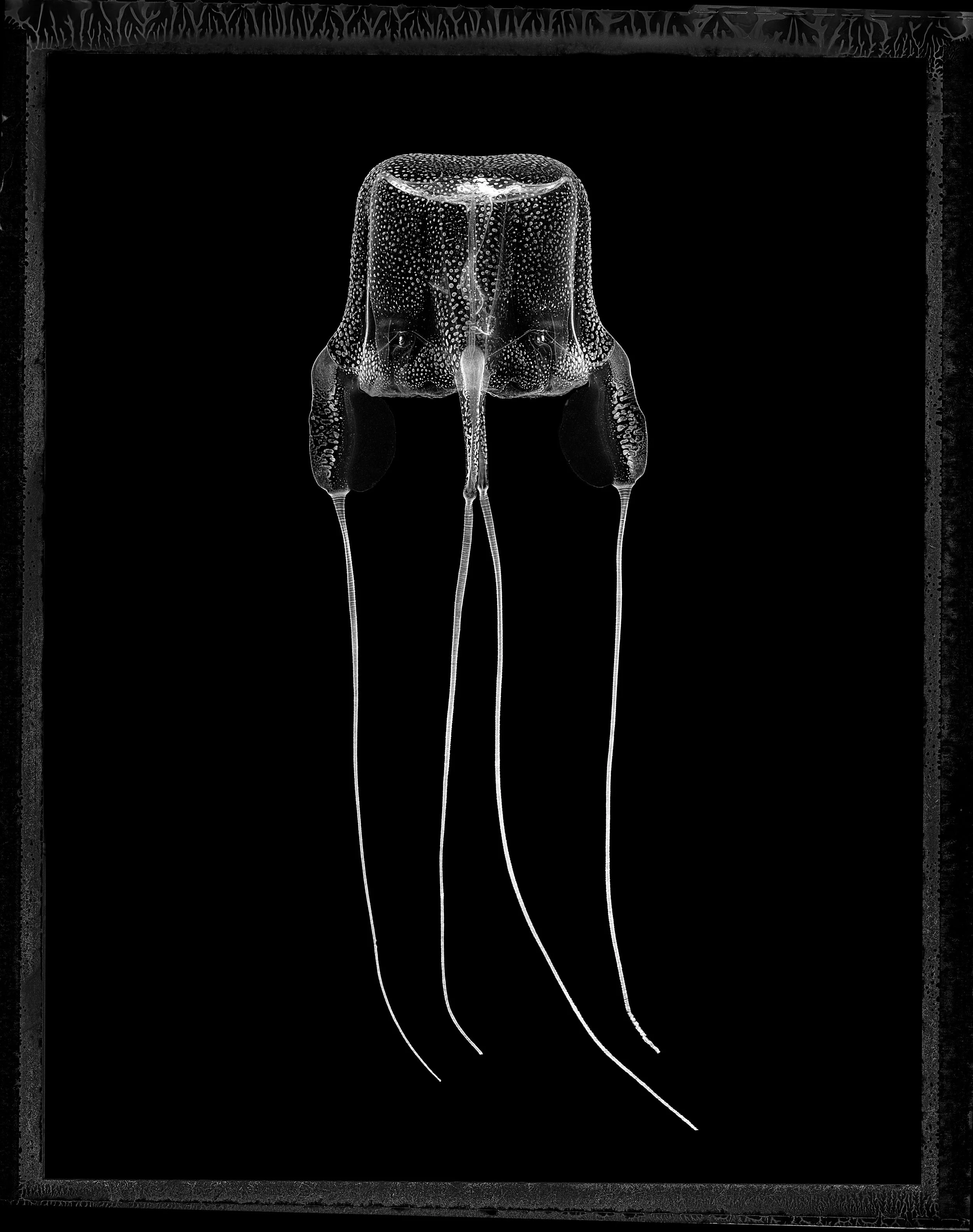
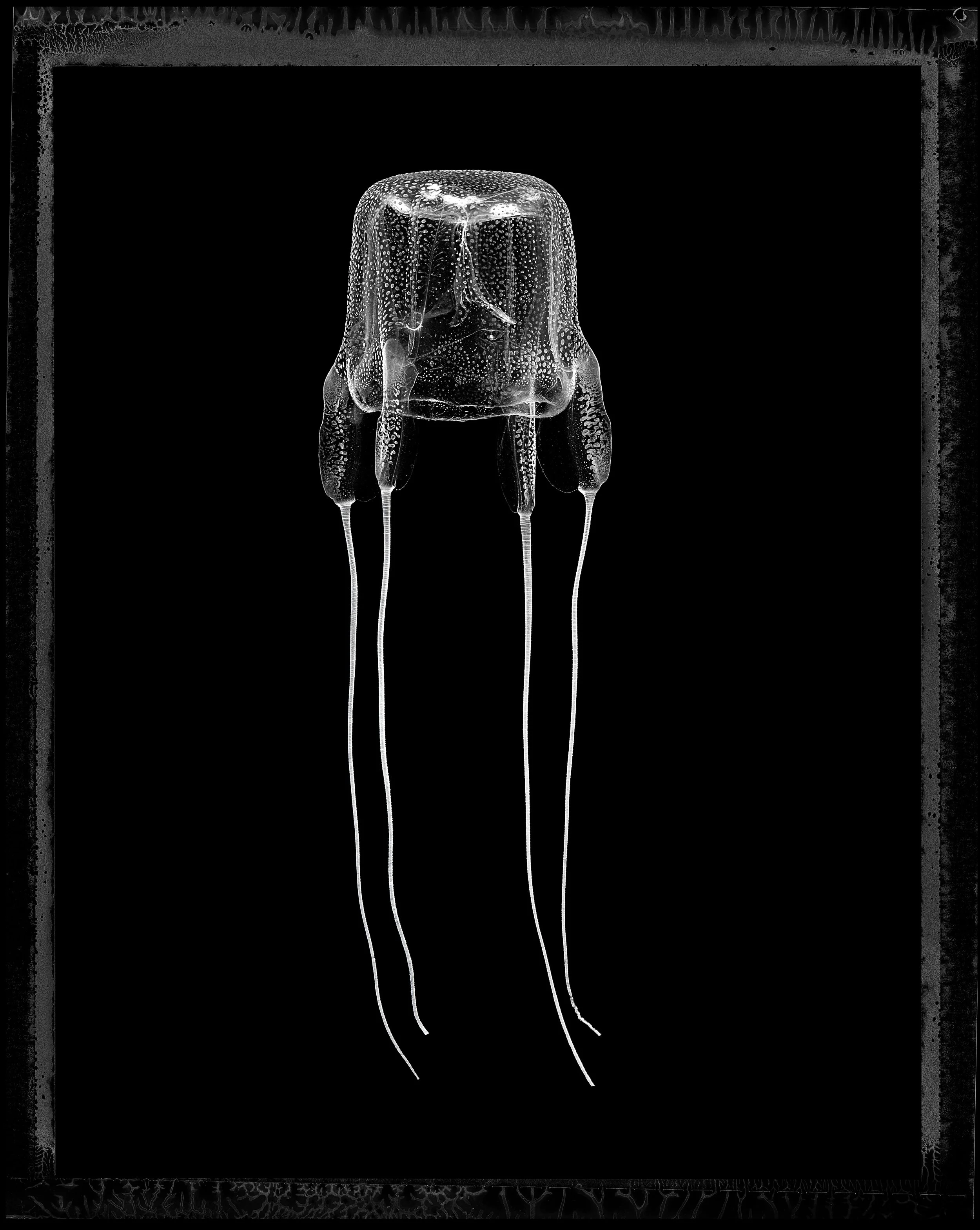
Let's consider one example that might help you engage your imagination at Jan C Schlegel's series. The box jellyfish, considered one of the most dangerous creatures on Earth, has another name: the sea wasp. Its venom can kill an adult in a few minutes if the victim is not treated in time. And yet in the photo from the series „of Aliens, Mermaids and Medusas“ she appears in a slightly different guise, more peaceful. The pattern of her head resembles the gaze of an elephant. As soon as you notice this look, your imagination will add the recognizable elephant skin texture and it will be very hard to get rid of this image, it will stay in your memory for a long time.
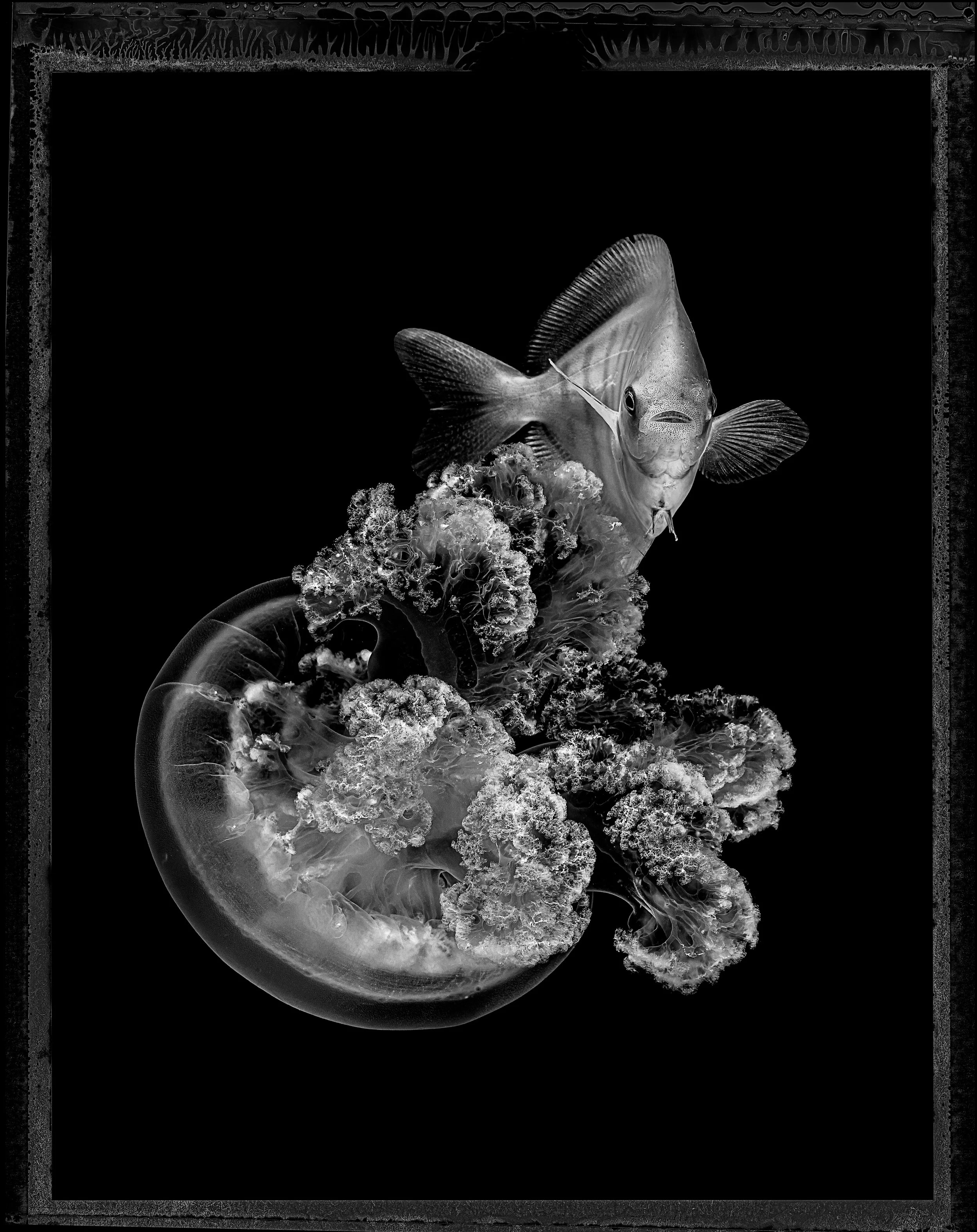
There is no point in telling what Jan l saw in all these amazing creatures. We'll just ask a few guiding questions to stimulate your imagination. Could you see a single jellyfish as a forest on a lonely planet? Would you have thought of the idea that a close friendship might develop between a jellyfish and a fish? Or maybe some picture reminded you of your childhood fears when you didn't want to get out from under the covers, being afraid of the monster under the bed? Would you find a woman's profile in one of Jan C Schlegel's works? As you look at the dancing tentacles, will you hear a melody dear to your heart?
The Series is dedicated to Ksenia Chapkayeva who also wrote this introduction. Her inspiration, encouragement and support were vital to see the series realized.
The Platinum Print: The Most Noble Print
For people who collect photographs, platinum prints are known for their beauty, gracefulness, archival stability and unique, one-of-a-kind print statement. Made from the salts of platinum, these prints are also called “platinotypes” or “platinum” prints.
Platinum is a noble metal on the Periodic Table and are resistant to oxidation. The platinum salt emulsion is imbedded into the fiber of the paper during the printing process.
As with most historical photographic processes, a platinum print is made by placing the negative and emulsion-coated paper in direct contact. Platinum prints have a different “look ” from silver gelatin or digital prints.
All platinum prints have a matte, not glossy surface, because the sensitizer is absorbed into the paper rather than sitting on the surface. A platinum print also has a more gradual tonal change from black to white. To the eye accustomed to the punch of a silver gelatin print, a platinum print will often feel “softer” or lower in contrast. In reality there are actually more steps between pure black and pure white in platinum prints than in a silver gelatin print. This contributes to the deeper, richer feeling you experience when looking at these prints.
Jan C Schlegel’s platinum prints are made from hand-mixed and hand-coated emulsions. These sensitizers are mixed just prior to use, coated on the paper with a brush. Once dry, a negative is placed in direct contact with the paper, and then exposed to sunlight or ultraviolet light. Exposure to the light source takes an hour or more, depending on the density and contrast of the negative.
The image tone of a platinum print can vary in color. These prints can range from a cool, slightly purple black to split tones of brown and warm black, to a very warm brown. The proportions of the different components in the emulsion, choice of developers and the temperature of the developer control the final color.
The platinum prints of the series are double layered like Irving Penn did it for some of his iconic images. To increase tonality and depth I also added in some of my images as a second component to the sensitizer some Iridium which makes the picture even more noble and creates more richness in the mid tones.
As these emulsions are mixed and coated by hand no two prints are exactly alike and become unique art pieces.