The concept of the muse is deeply rooted in ancient Greek mythology, where the Muses were nine goddesses who presided over the arts and sciences. The word “muse” comes from the Greek mousa, meaning “to inspire.” Over time, this idea evolved, and by the 19th and 20th centuries the muse often became a romantic and personal figure in the lives of artists.
The history of art is full of the idea of solitary geniuses—men and women who seemingly pulled masterpieces out of the ether of their own minds. This is a fallacy. Behind, beside, and often ahead of these men stood the Muse. A term we too easily use today, mostly to point out the inspiring beauty of a model. I heard it many times and started to wonder what a “Muse” actually is.
For me, it became a personal search for understanding. I love photography as an art form, and I take pictures of many things, but portraiture (including the nude) is where I feel most alive and most challenged. I also feel the need to go deeper into this genre in order to create something truly relevant for society in our times.
I took many portraits of many women, but I felt that most of them, though beautiful, lacked the emotional depth needed to truly connect with the viewer. I didn’t want to continue down that path without understanding how to get more emotional energy into my work. Otherwise, I felt I would just create a collection of beautiful women and place them on a shelf without any meaning.
I discovered that taking a portrait is always also a self-portrait, where my own intentions and emotions become visible. It’s like the picture is a window and a mirror at the same time. The window through which you see the person photographed—the beauty, the shapes, the form, the play of light and shadow on the skin—but also a revelation of the soul of the person. A portrait is not simply someone standing in front of a photographer; it is when the person reveals herself. It requires enormous trust and openness.
The mirror is where the picture shows the photographer—the way he sees his “model,” the way he feels for her. The depth of love, admiration, affection… it is much deeper than the word “beauty.”
Making a portraiture picture is a dialog between the Artist and the person in front.
For a photograph to become art, it needs to be true. The emotions need to be real, not staged in a simple way. The more truth a picture holds, the more the viewer is able to feel and connect with it. Painters and sculptors know this concept very well, but in photography we too easily try to stage emotions because we believe the camera creates the image and not the artist.
In my life I discovered that love and beauty are the two elements that inspire me personally the most. That’s why I started to look into the idea of the muse and began to study some of the modern artists. In this text I want to share a little bit of what I discovered. It helped me understand my own life better. I studied the last months far more artist then the ones mentioned here and found with all the same patterns.
However, the Muse is not merely a passive “object” of beauty to be observed. In the most profound artistic relationships, the Muse is an active participant—a collaborator, a critic, and often an artist in their own right.
The relationship is less about “possession” and more about a shared vision. For artists like Rodin, Modigliani, Schiele, and Rivera, the Muse was the missing chemical element needed to stabilize their volatile genius.
In return, these “Masters” often acted as mentors. They did not just paint their muses; they taught them, challenged them, and pushed them toward their own artistic self-actualization. In the last weeks and months I have been studying this complex reciprocity, where love and art become indistinguishable, and where the Muse is revealed to be a co-creator of immortality. I wanted to understand not only history, but also myself.
Her long neck, almond eyes, and quiet presence gave physical proof that his way of seeing the world was real.
More importantly, Modigliani was consumed by addiction and illness. Jeanne provided the stability and unconditional love that allowed him to paint. In the final three years of his life—their years together—his work matured into the iconic style we recognize today. She was the calm clarity that allowed him to focus his chaotic genius onto the canvas. Just a few days ago I stood at their tomb in Paris, where they are buried together and share the same words on their grave stone.
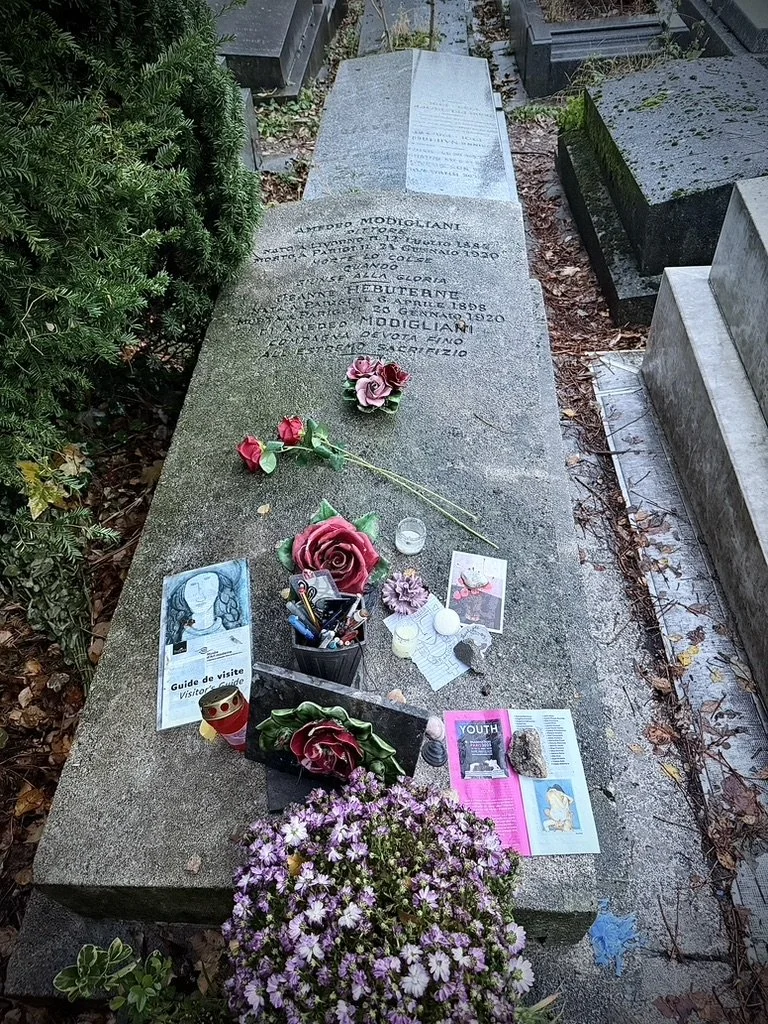
Grave of Amedeo Modigliani and Jeanne Hébuterne
Schiele and Wally represent the “us against the world” dynamic, where the artist and the Muse build a private kingdom where art is the only law.
They were partners in a literal sense. They left the constraints of Vienna to live in the countryside, seeking a place where they could live and create freely.
Schiele elevated Wally from an anonymous model to an icon of Expressionism. He didn’t just paint her; he collaborated with her on the poses. The contorted, angular, challenging postures in Schiele’s work required a model who understood the intention. He taught her to use her body as an instrument, like a dancer. He treated her as a co-manager of his work and finances.
Schiele’s art was aggressive, neurotic, and disturbing. He needed a muse who was fearless. Wally provided a lack of inhibition that matched his own. She allowed him to explore the darkest corners of human emotion without judgment. Without her willingness to enter this radical space, his work would have lacked its signature intensity. She was the conduit through which he channelled his anxiety.
When we analyze the “success” of the Muse, we must look beyond the canvas. The traditional narrative suggests that the Artist takes the Muse’s beauty and gives back only a painting. But the reality of these relationships shows a deeper exchange. I find that deeply fascinating.
The Artist often served as the gatekeeper and guide. Rodin gave Claudel the tools; Rivera gave Kahlo confidence; Schiele gave Wally purpose and a legacy. In many cases, the Artist pushed the Muse to success by validating her worth in a world that ignored women.
They acted as mirrors, reflecting the Muse’s potential back to them—amplified.
The question that arises from these histories is one of existential necessity:
Would these masters have become famous without the emotional and intellectual influence of their Muses?
The answer is almost certainly no.
While these men possessed great technical talent, the specific alchemy that elevated them from “skilled craftsmen” to “immortal icons” depended on their Muses. It was a co-dependency, where the Muse provided the substance that the Artist gave form to.
Consider Rodin without Claudel: a highly competent sculptor of monuments, but likely never accessing the tortured, intimate depth of “The Kiss”.
Consider Rivera without Kahlo: reduced perhaps to propaganda—political but without soul.
Consider Modigliani without Jeanne: burning out earlier, without ever crystallizing his style.
The Muse was not only a spark; she was the engine. These women provided the intellectual friction, the emotional devastation, and the domestic stability needed for great art. They managed the artists’ challenges and created the environment where genius could survive. Without them, the “master” might still have painted—but the world probably wouldn’t be looking at those paintings today.
The relationship between the Artist and the Muse is rarely a fairytale, but it is the foundation of modern art history. It is a story of mutual creation.
The Artist often served as the mentor, pushing the Muse to realize her own value and voice.
In return, the Muse gave the Artist the one thing he could not generate alone: a soul for his technique.
The Artist may hold the brush, but the Muse often guides the hand.
Ultimately, these masterpieces are not the work of solitary men, but the enduring artifacts of two spirits colliding—proving that while the name on the canvas is singular, the creation was plural.
Studying these histories showed me that the greatest works of art were never created by the artist alone. They were born in the fragile, transformative dialogue between two people that are connected. And I feel this truth inside me now more clearly than ever.
When I look back at my own portraits, I realize that the images with emotional gravity were always made with someone who allowed me to enter that deeper space. Those moments were never just technical achievements; they were born of connection, intimacy, and something shared between two souls.
The Muse, as I understand it now, is the emotional catalyst — the element that binds everything together and makes it possible to create art that truly reaches the viewer....