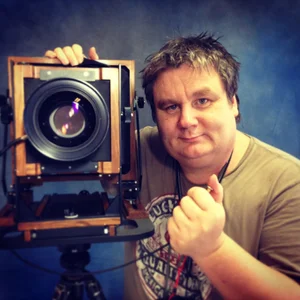
If I learned one thing in Kenya while photographing a Northern White Rhino, it is that making a drawing of a setup — even a very detailed one using AI — and actually doing it in the field are two completely different things.
There are simply too many things you cannot control.
The wind. The clouds and the light you are waiting for. The backdrop that suddenly behaves very differently outside than it did in your imagination.
And, of course, the rhino.
Najin was much bigger in reality than she had appeared in my drawings.
I am soon on my way to Busan with another beautiful drawing of another rather complicated setup. I made it to explain the idea to the people whose help I will need, and I even had it translated into Korean.
I feel well prepared.
But after Kenya, I also know that this probably means very little.
The next photograph for Paradise Lost will take me to Busan in South Korea. It will involve at least 20 living octopuses in different sizes and species. I already bought a children’s swimming pool that I will take with me to Busan, I also will use the same linen backdrop that appears throughout Paradise Lost. Camera and light with softbox are waiting with me for the flight … hopefully soon since prices are dramatically expensive right now.
I feel prepared and ready.
Let’s see what reality thinks about my plans.
But back to Najin.
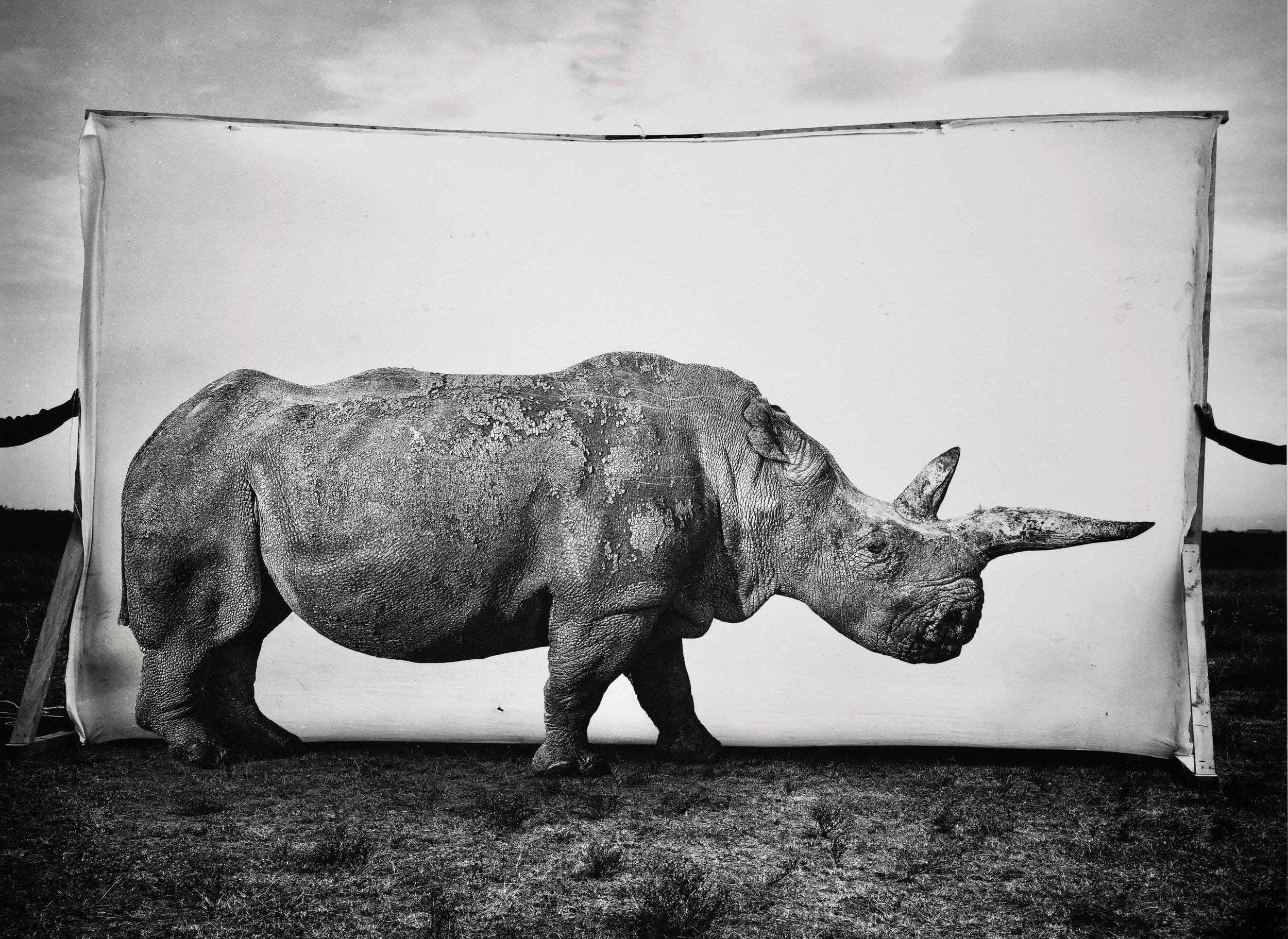
Scan of the 40×50 Platinum Print of Najin
In an earlier post I shared the idea of photographing Najin, one of the last two remaining Northern White Rhinos on Earth, and later I wrote about what actually happened when I tried to make that photograph.
From quite early on, the vision was to eventually turn the photograph into a life-size platinum print.
When a friend and I first talked about this idea, it was exciting. I could immediately imagine the power of the photograph at that scale — standing in front of Najin almost as I had stood in front of her in Kenya. He met Najin just a few weeks earlier and was full of excitement sharing about the encounter. Of course in the conversation he knew already that what I want to do is very difficult and tried carefully to explain to me the challanges, the size of the animal, the size of the backdrop needed… it was like I didn’t really listened thinking… details, lets work on that later.
It sounded wonderful.
Then I actually took the photograph. And the story is written down on a previous post at my websites private viewing room.
Now Najin is in front of me as a 40 × 50 cm platinum print, and I started asking the rather obvious question:
How in the world do you make this 1:1?
I contacted my friends at Salto Ulbeek in Belgium. In my opinion, they are among the most advanced platinum printers working today, and they have experience producing exceptionally large platinum prints.
I explained the idea to Georges.
He calculated.
5.6 metres wide.
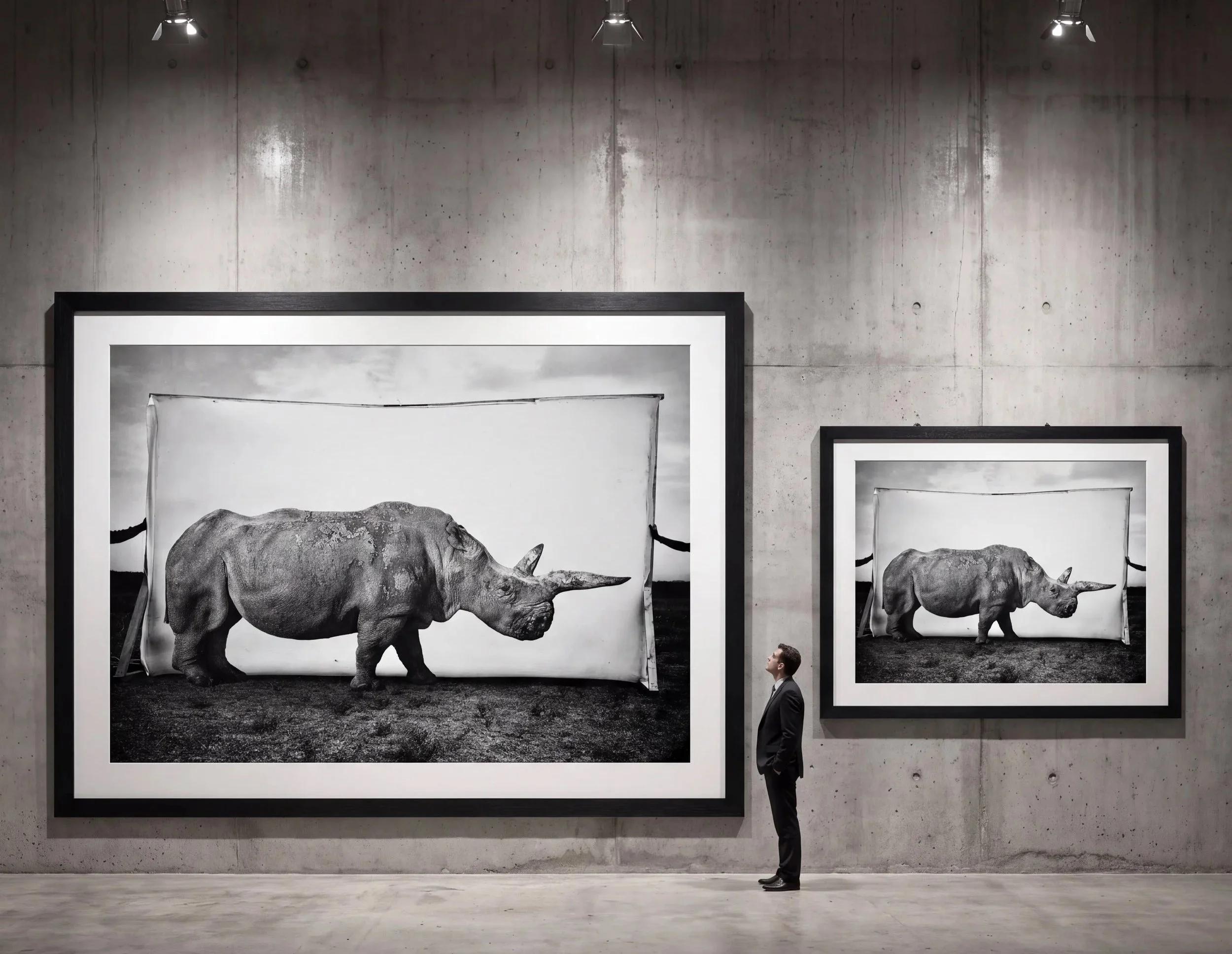
5.6 Meter versus 2.4 Meter
That would be the size required to bring Najin close to life scale.
It is crazy.
It would certainly become the largest platinum print ever made.
Fortunately, Georges likes challenges like this. Instead of telling me that I was completely insane, he became interested and immediately started thinking about how it could actually be done.
Then came our next conversation.
And that one brought me rather quickly back down to earth.
One photograph. Twenty-five platinum prints.
A platinum print cannot simply be made 5.6 metres wide. No paper exists in that size that is suitable for the platinum print. Coating such a large area would be impossible. Developing and processing also.
The image would have to be produced from approximately 25 individual platinum prints. These would then have to be assembled by a specialist so precisely that the joins effectively disappear and the individual sheets become one image.
That is already quite an undertaking.
But there is another problem I had not really thought about.
Once assembled, a photograph of this size cannot simply be packed into a crate and sent somewhere.
Georges explained that the final mounting of the 25 prints and probably also the framing would have to happen at the place where the work is going to be exhibited.
In other words, the 5.6-metre Najin would have to be created at its destination.
I had imagined showing it at an art fair. and that would be definitely amazing looking.
Georges brought me back down to earth once again.
How do you transport it?
How do you store it?
What happens if it does not sell?
Where does a 5.6-metre platinum print go after the fair?
All very good questions.
Questions I had conveniently not asked while imagining the photograph.
So we began discussing a second version.
The largest size that could still reasonably be transported would be approximately 2.4 metres wide. It would still have to be made from several platinum prints and assembled with great precision, but it would remain a work that could travel to galleries, exhibitions and art fairs.
I am also considering another edition at approximately 120 cm wide — around the largest size at which we could make the platinum print without stitching multiple sheets together.
So suddenly one crazy idea has turned into an entire production strategy.
But Georges also said something that has stayed with me.
He believes the 5.6-metre print would be breathtaking.
At that scale, you would no longer simply be looking at a photograph of a rhino. You would have something closer to the physical experience of standing beside Najin.
And platinum matters here.
The extraordinary depth, surface and tonal range of a platinum print could give her skin and presence something that I don’t think another printing process could give me.
The more I think about it, the more I believe the 5.6-metre work should exist.
But perhaps Georges is right about something else as well:
A work like this belongs in a museum.
The 2.4-metre version could travel. It could be shown at an art fair or gallery. And beside it we could explain the original vision — the 5.6-metre life-size platinum print — and offer the possibility of producing it for a museum or institution capable of exhibiting it permanently or for a substantial period of time.
At the moment, this seems like the most realistic way forward.
Although I am still looking for ideas.
Then came the quotation.
This brought me even further back to earth.
Even after a very substantial discount, producing the 5.6-metre platinum print would cost approximately:
€48,000.
The 2.4-metre version:
€11,520.
And that is before solving all the other questions surrounding mounting, framing, installation and transportation.
I simply cannot put €48,000 on the table to see whether my crazy idea works.
So now another part of Paradise Lost begins.
Finding a museum.
Finding a partner.
Perhaps finding a collector or institution that believes strongly enough in the work to help make it possible.
I don’t know yet.
And strangely, I think that is okay.
Because I realized something while thinking about all of this.
If somebody had explained to me at the beginning everything that would be involved in turning this photograph into the work I imagined, I probably would never have started.
Maybe that is why it is sometimes better not to know everything at the beginning and maybe naively ignoring the difficulties involved.
You see the mountain.
You know roughly where you want to go.
But you don’t need to know every difficult step that waits between where you are standing and the summit.
You just take the next one.
And then another.
Eventually, perhaps, you arrive.
So far, every photograph for Paradise Lost seems to work this way.
Borneo was like this.
Kenya was certainly like this.
Now I am thinking of my next picture, the swimming pool, a linen backdrop and a plan involving living octopuses in South Korea, I have the suspicion that Busan will be no different.
But I like this.
I am learning an enormous amount with every photograph. I also learn to trust even though I cant control all the details.
And slowly I am beginning to realize that Paradise Lost is not only becoming a series about the natural world, about wonder, loss and the things disappearing around us.
It is also becoming a series about discovery.
Including my own.
For now, the 5.6-metre Najin exists only as an idea, a small platinum print, a calculation and a problem that I have not yet solved.
But I would very much like to see her standing there one day.
Life-size.
Not simply as a photograph of one of the last Northern White Rhinos.
But as a monument to her.
And perhaps that is reason enough to keep taking the next step.
If you know a museum, curator, collector or institution that you think should see this work — or if you simply have an idea I have not considered — please write to me.
Sometimes the next step comes from a direction you didn’t expect.