Now preparing for the next photograph in Paradise Lost.
The Old Pear Tree
An Overlooked Paradise
Paradise is not always found in distant rainforests, beneath the oceans, or among the last survivors of an endangered species. Sometimes, it has been standing quietly in a meadow just beyond our doorstep for centuries.
The traditional European orchard, the Streuobstwiese, is one of those overlooked paradises. Created through generations of human care, these landscapes became extraordinary ecosystems. Their old apple and pear trees provide shelter and nourishment for countless insects, birds, bats, fungi, and other forms of life. Yet, over recent decades, much of this landscape has disappeared, often without us even noticing.
In southern Germany, where I grew up, these old orchards and trees were once a familiar part of the landscape. Recently, I returned to the region, hoping to find some of them again. But where I remembered old, irregular trees standing in meadows, I found rows of commercially cultivated apple and pear trees instead. One row after another. Trees grown for efficiency, uniformity, and maximum yield.
The fruit was still there. But so much of the life surrounding it seemed to have disappeared.
For Paradise Lost, I want to photograph one of these old pear trees. Not necessarily the largest or most beautiful, but one that carries the marks of time. A twisted trunk, broken branches, perhaps a hollow interior. A tree that has endured storms, droughts, and generations of human history, yet continues to bear fruit. And within and around it, an entire world of life: birds nesting in its branches, insects living beneath its bark, fungi growing in its wood, and small animals finding shelter among its roots.
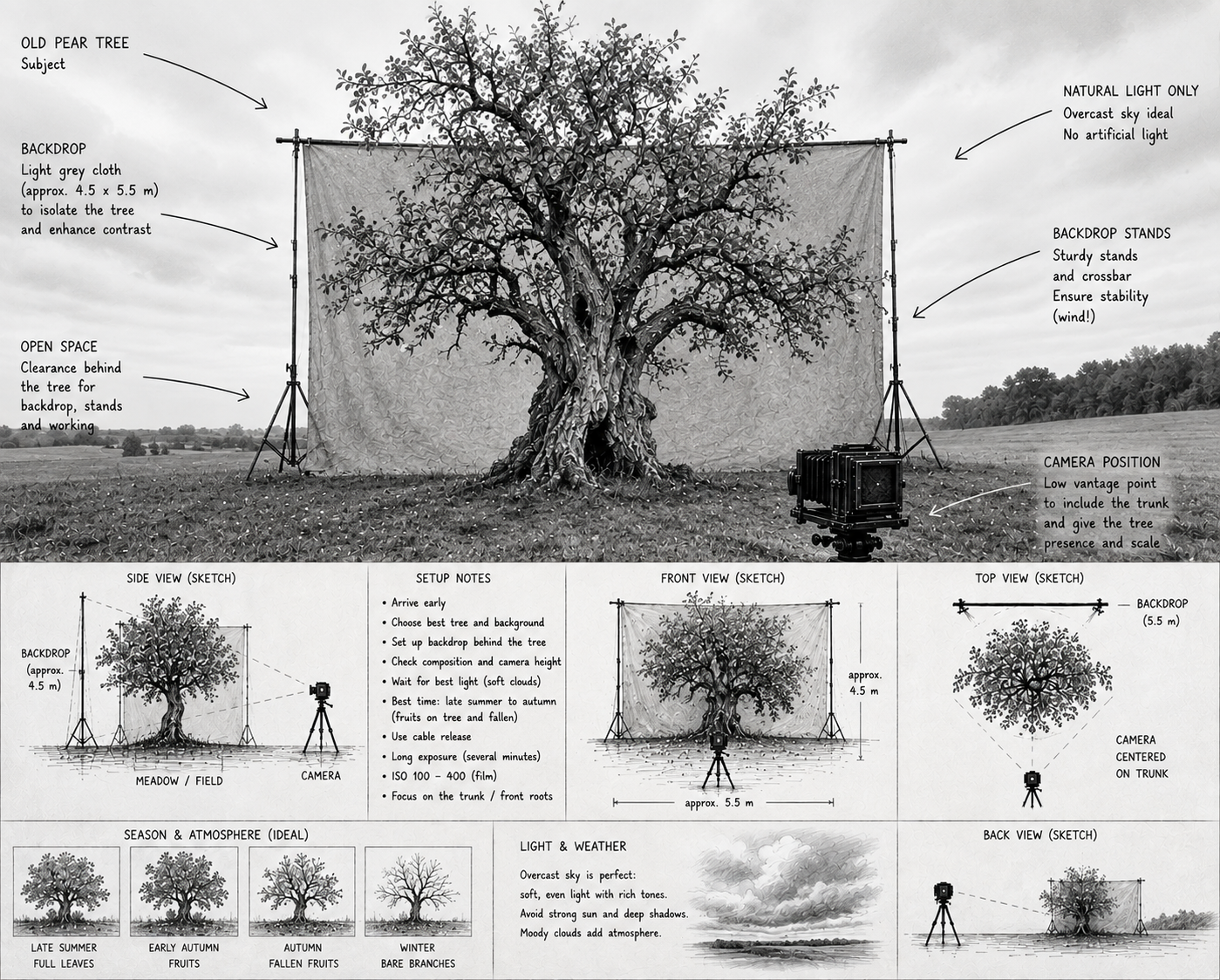
As with the other photographs in this series, I will place a simple backdrop behind the subject, temporarily separating it from its surroundings. The tree becomes a portrait. Something familiar becomes extraordinary. Something we might otherwise pass without noticing demands our attention.
The last weeks and months I was preparing for the picture. I was in contact with some government offices that are taking care of protected nature areas and especially of those trees. They were very excited when they heard about the project and helped me to locate several of those trees. I also got in contact with some old farmers and NGOs protecting those trees. It was remarkable what I learned through all their input.
I contacted a company who usually makes their curtains and they helped me with a 6x6 Meter backdrop. I have telescope sticks that hopefully are strong enough to hold the backdrop. Now slowly the whether changes and I have already some of the leaves fallen to the ground and maybe even some fog that I would like for the picture… Im preparing for the middle of November to take the picture and pay a visit to my favorite of the selected trees this weekend.
There is something deeply meaningful to me about placing this humble pear tree alongside a rhinoceros, the octopuses, and the extraordinary insects of the rainforest.
Because Paradise Lost is not only about the disappearance of rare and distant wonders. It is also about losing what was once ordinary.
And perhaps that is the most unsettling kind of loss: when something disappears so slowly that we forget it was ever there.
We protect only what we first learn to love.
That is what Paradise Lost is about.