First of all: yes, I got picture number four in Busan, and I am already working on the print.
Of course, I was incredibly eager. After arriving home, I went almost immediately into the darkroom to develop the films. I was very nervous because, after everything that had happened in Busan, I honestly thought the chances that I had succeeded were not very high.
But I have it.
Maybe I actually have two.
They are very different from what I had envisioned, but perhaps better because of that. And one in particular feels almost like a miracle. It is absolutely perfect. As soon as I have finished the print, I will of course share it here.
But for now, I am still working on the print.
I have many, many test prints lying in front of me. This is probably one of the most demanding and difficult prints I have ever made. The line between life and death in this image is incredibly fine. Small changes in contrast and density completely change the photograph.
I also decided that I want this image to become a platinum/rhodium print rather than my usual platinum/palladium print. Rhodium is an exceptionally rare and precious metal. More importantly for me, it changes the tonality of the print, particularly in the midtones, and gives me a separation and contrast that I could not achieve in quite the same way with platinum/palladium. I also like the idea that the material itself makes the finished object even more rare and precious—although, unfortunately, it also makes it considerably more expensive to produce.
I made test prints on four different papers and finally decided on a beautiful 27 gsm handmade Japanese Tosa paper. It is extremely thin and delicate, and there is something about its surface that works remarkably well with the skin and texture of the octopuses. Its natural white tone is also beautiful with platinum. The paper is not completely flat or uniform, and that slight irregularity somehow reinforces the feeling of water in the photograph.
Unfortunately, it is also incredibly difficult to work with.
Coating it is a nightmare. The paper absorbs the platinum solution almost like blotting paper, and I had to find a way of coating it without using a brush. Eventually, I began coating a large sheet of glass with the light-sensitive platinum/rhodium solution and then carefully laying the Tosa paper onto the wet surface. Even with this method, I need roughly three times as much solution as I would use to coat a conventional cotton paper such as Arches Platine.
After many, many test prints, I finally dared to make the first print at almost one metre.
I calculated that I would need at least 60 ml of solution, but I had no experience coating a sheet of Tosa paper at this size. After laying the paper onto the coated glass and carefully peeling it away again, I could already see a few areas where the coating was too weak. I tried to correct them very carefully with a soft brush.
Then I exposed the print under UV light.
And then came the moment of development.
It looked fantastic.
For a moment, I thought I had it. But when I looked more closely, I found several small areas where the coating had not been sufficiently even.
Still, I am excited.
Because now I can see the print. I know that it works. It has the feeling and the energy I was searching for.
Five days of work so far.
I put whatever is necessary into a print: time, learning, testing, materials, money. But I also always stay open to change. I may begin with a clear idea of what I want, but the process teaches me, and I have to be willing to listen. If another paper works better, I change the paper. If another process gives the image what it needs, I change the process. If something I believed at the beginning turns out to be wrong, I let it go and begin again.
I could never be satisfied with a print if I knew that I was capable of making it better. It does not matter how much work has already gone into it. The question is only whether I have taken the image as far as I possibly can.
Perhaps this is why the printing itself means so much to me.
For me, the print is the photograph.
The photograph is not the idea I had before going to Busan. It is not the moment when I stood above those octopuses and pressed the shutter. That moment created the negative—the possibility of a photograph. But the photograph itself still had to be made.
It happens here, in the darkroom: through decisions, failures, materials, chemistry, testing, looking, changing, and trying again. This is where I decide what the negative will finally become.
The print is the photograph. The print is the artwork.
I have learned so much again through making this one image. Now I am waiting for new chemicals to arrive so that I can make the print again—hopefully this time with a perfect coating.
Until then, the video already gives a first impression.
But a screen can only show the image.
The real print, standing in front of you, reveals its true beauty, materiality, and energy.
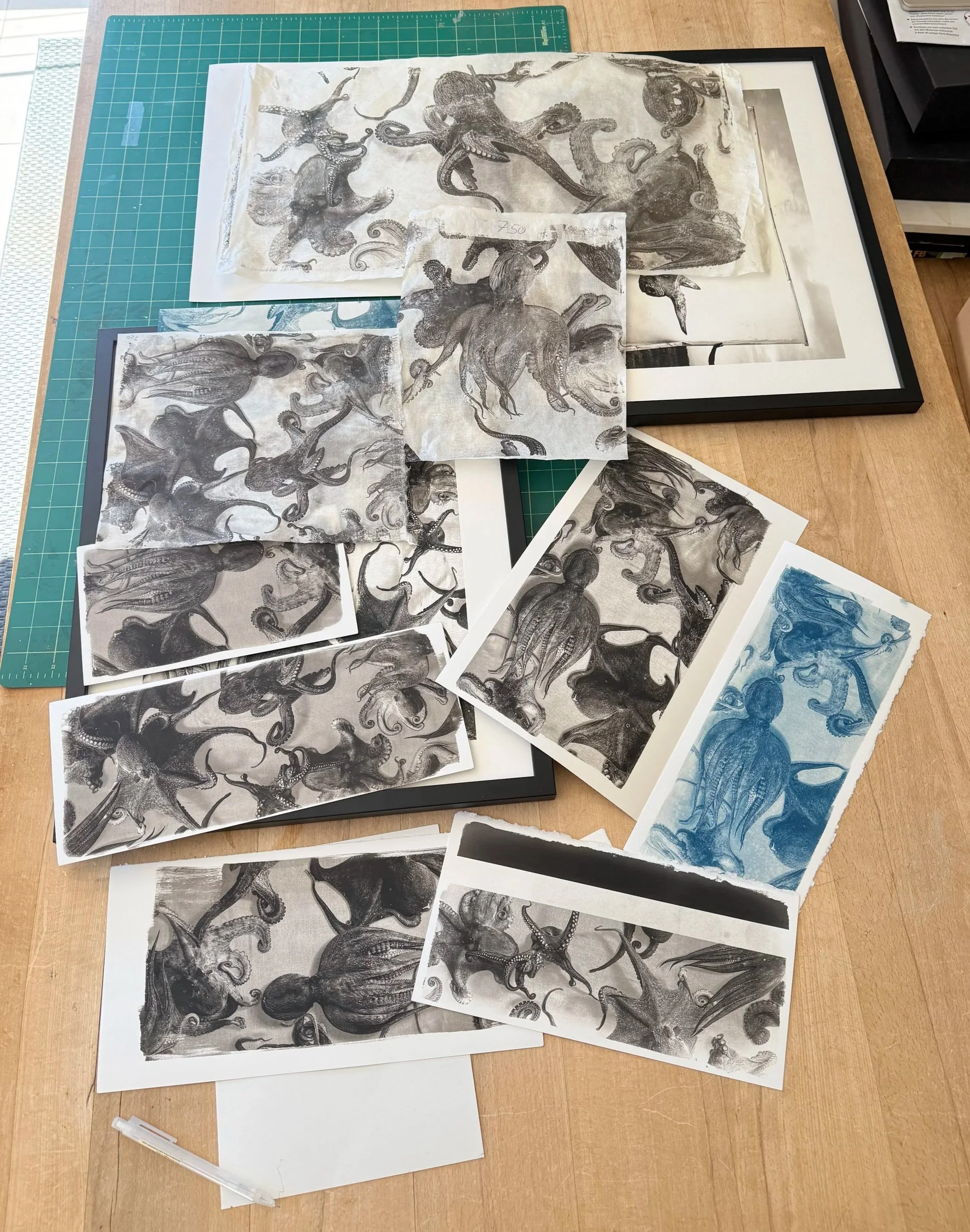
Test Print for Coating
Final print but unfortunatly with coating errors..