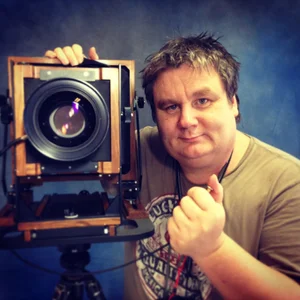
The Busan octopus print is finished.
In my last entry, I wrote that I was waiting for new chemicals so that I could attempt the large print again. Now it is here in front of me: a platinum/rhodium print on Tosa Gampi, almost one metre in size.
And I think it has become one of the most beautiful prints I have ever made.
Before travelling to Busan, I had a vision of the photograph.
Many living octopuses.
A shallow pool of seawater.
White linen beneath them.
The camera looking directly down.
But the image in my mind was never complete. It could not be, because its most important part was alive.
When the thirty-three octopuses entered the water, they did not become elements within my composition. They moved wherever they wanted. They touched, separated and crossed one another. Their arms disappeared beneath other bodies and emerged somewhere unexpected. They changed colour and texture. Each movement disturbed the water and transformed the entire picture.
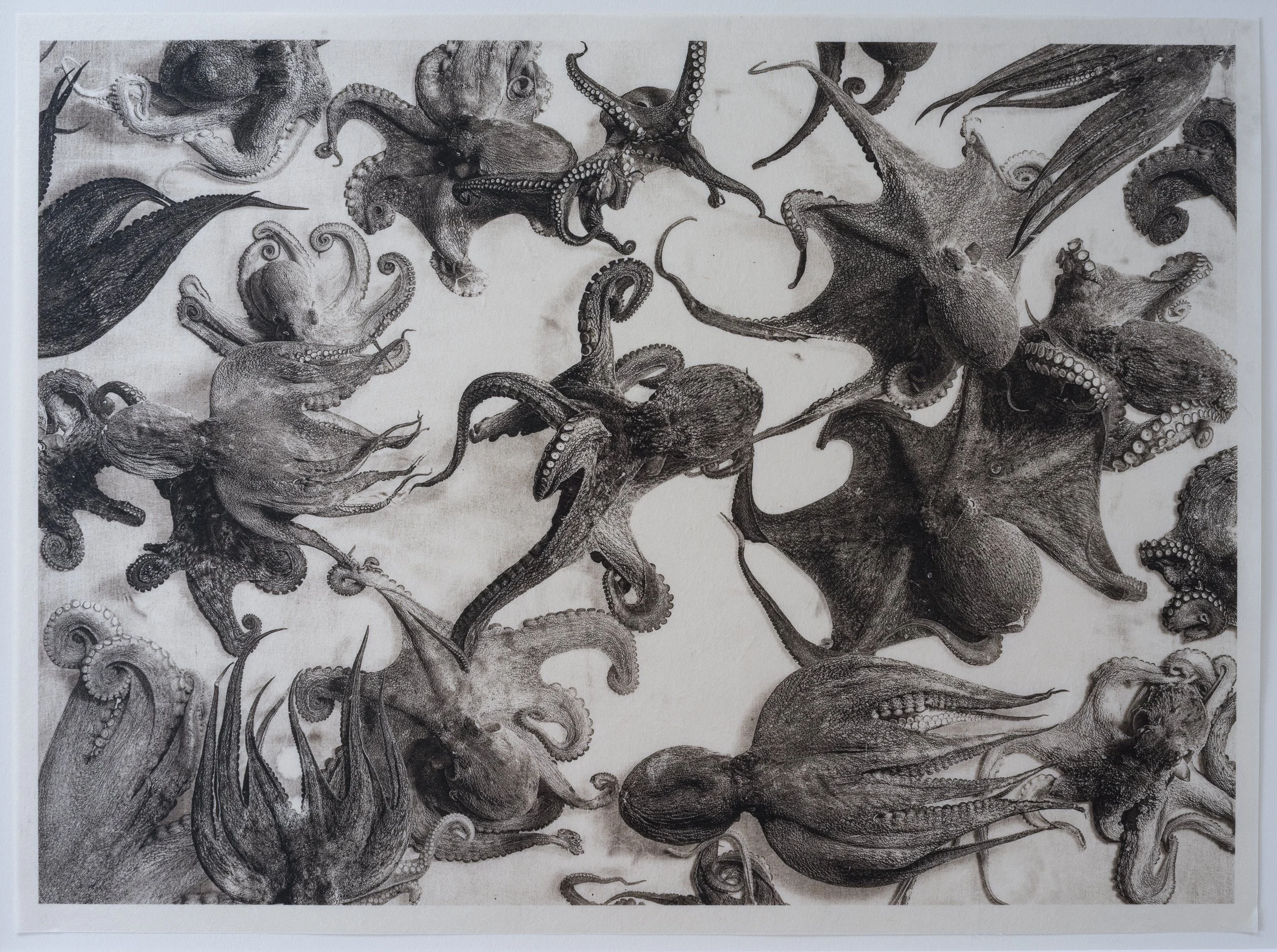
32×43cm, Platinum Rhodium Print on handmade Tosa Gampi paper
At first, I tried to arrange them.
Then I understood that I could not.
I stopped touching the water and began to watch.
The camera was suspended above the pool, and I could not look through it. I had to hold the rectangle of the image in my mind while watching everything that happened below it.
Every few seconds, a new possibility appeared.
Then it was gone.
All I could do was remain attentive and decide when to release the shutter.
When I developed the negative, I knew immediately that the photograph was very different from the one I had imagined.
But I could not yet understand what it had become.
Only now, in the finished print, can I see it.
Twenty-seven octopuses are visible inside the frame.
Some appear completely. Others only partly. Arms enter from outside the image, while bodies continue beyond its edges. The pool was wider than the camera could contain.
There was more life than there was space inside the photograph.
When I first look at the print, I see abundance—a mass of bodies, arms, movement and water.
But the longer I look, the multitude begins to separate.
One animal emerges.
Then another.
One arm.
One eye.
One gesture.
One becomes almost black. Another stretches itself across the pale linen. Some seem to withdraw, while others reach out and make contact.
I find myself trying to choose a favourite.
The strangest.
The most beautiful.
The one that astonishes me most.
But every time I choose one, another pulls my attention away.
They are not a mass.
They are individuals.
Perhaps this is what abundance can conceal from us. Numbers make life appear anonymous. Thirty-three octopuses. Thousands of insects. Millions of fish.
But abundance is not sameness.
It is individuality multiplied.
The finished print has also transformed my memory of Busan.
The reality was hot, exhausting, improvised and in constant motion. I was kneeling beside a children’s pool in a parking garage, trying to see everything at once without knowing whether I had succeeded.
The print is the opposite.
It is quiet.
It holds all that movement within one still moment. Relationships that existed for only a fraction of a second can now be followed slowly. One curve answers another. An arm connects two bodies. Darkness opens into water. Areas of density are interrupted by unexpected spaces of calm.
I could never have arranged this.
I could never have imagined all these relationships in advance.
That is precisely why the photograph matters to me.
We often speak about artistic vision as if the artist must first see the finished work internally and then force reality to reproduce it.
I do not believe that anymore.
Vision is necessary. It gave me a direction and brought me to Busan. It made me carry a children’s swimming pool halfway around the world and construct a place in which the photograph might happen.
But vision could only take me to the threshold.
Beyond it was uncertainty.
For a long time, I thought uncertainty was something standing between me and the work—something that preparation, experience and control should gradually remove.
Now I think uncertainty is needed to create art.
If I know exactly what the finished work will become, I can only produce what I already know.
The unknown contains every other possibility.
The photograph did not become powerful because reality fulfilled my vision.
It became powerful because reality exceeded it.
I had to release the image I had imagined before I could recognise the one that life placed in front of me.
The photograph accompanying this entry shows the finished print. I have also made a video that moves across the large Tosa Gampi print and allows you to come closer to its surface and details.
Of course, neither can replace standing in front of the original. But perhaps they can reveal something of what happened between the idea and the finished work.
Between vision and reality.
Inside the uncertainty where the photograph finally became itself.
And while this print is now finished, Paradise Lost is already leading me towards the next photograph.
I am searching for a very old pear tree.
I have had an enormous backdrop made for it—six by six metres. That is the part I can prepare.
Now I am waiting for autumn.
For its changing light.
Its beauty.
Its fog.
I already carry a vision of the photograph within me. But after Busan, I understand more clearly that this vision is only the beginning. I do not yet know which tree I will find, what the day will give me or what the final picture will become.
And I am glad that I do not know.
I am excited by everything this project is teaching me—and curious to discover where it will take me next.